Answer Engine Strategy
Answer Engine Optimization (AEO)
Builds an answer engine optimization (AEO/GEO) plan so content gets cited by ChatGPT, Perplexity, Gemini, Claude, and Google AI Overviews: answer-first structure, entity coverage, citation-worthy data, and AI-visibility measurement. Use…
---
name: aeo-strategy
description: >-
  Builds an answer engine optimization (AEO/GEO) plan so content gets cited by
  ChatGPT, Perplexity, Gemini, Claude, and Google AI Overviews: answer-first
  structure, entity coverage, citation-worthy data, and AI-visibility
  measurement. Use when the user wants to rank in AI search results or get their
  brand cited by AI assistants. Triggers on: "AEO", "answer engine
  optimization", "AI search", "generative engine optimization", "GEO", "optimize
  for AI search", "get cited by ChatGPT".
license: MIT
compatibility: Claude Code, Codex, GitHub Copilot, Cursor, Gemini CLI, OpenCode, Goose, Hermes, Windsurf, Zed
metadata:
  version: "1.0.0"
  author: LeadMagic
  category: content-seo
  tags: [content-seo, AEO, AI-search, answer-engine, generative-search]
  frameworks:
Overview
AI search engines (ChatGPT, Perplexity, Gemini, Claude) are capturing 10-30% of B2B search traffic. Traditional SEO doesn't optimize for AI answers. AEO ensures your content is the source AI engines cite when users ask questions in your domain. This skill covers the strategy.
Manual install (npx, ZIP)
npx skills add LeadMagic/gtm-skills --skill aeo-strategy -g -a claude-codenpx degit LeadMagic/gtm-skills/skills/content-seo/aeo-strategy#main ~/.claude/skills/aeo-strategyConnects with Agent Alley MCP · agentalley.io/mcp
Files included
SKILL.md8.3 KB
Read SKILL.md here
Show the full text176 lines
Answer Engine Optimization (AEO)
Overview
AI search engines (ChatGPT, Perplexity, Gemini, Claude) are capturing 10-30% of B2B search traffic. Traditional SEO doesn't optimize for AI answers. AEO ensures your content is the source AI engines cite when users ask questions in your domain. This skill covers the strategy.
Authoritative Foundations
- Google Search Central — AI features and your website — AI Overviews and AI Mode draw on pages that are indexed and snippet-eligible; there is no special markup, so SEO fundamentals decide inclusion.
- Google Search Central — SEO Starter Guide — Write people-first content with clear headings and descriptive anchors so pages are easy to crawl, understand, and quote.
- Aggarwal et al. — GEO (Generative Engine Optimization, 2023) — In controlled tests, adding citations, statistics, and quotations raised a page's visibility in generative answers; add evidence, not keywords.
- schema.org structured data — Mark up organizations, products, FAQs, and authors so engines can resolve entities and attribute answers to your brand.
When to Use
- "Optimize for AI search"
- "AEO strategy"
- "Get cited by ChatGPT"
- "Generative engine optimization"
- "Rank in AI search results"
Step-by-Step Process
Phase 1: Understand How AI Search Works
AI search engines:
- Receive a user query
- Search the web for relevant sources (often using Bing/Google APIs)
- Read the top sources
- Synthesize an answer, citing specific sources
- Present the answer with citations
Your goal: be the source they cite. This requires being the most authoritative, clear, and well-structured source on the topic.
Phase 2: AEO Content Principles
- Authoritative voice: Cite specific data, name specific experts, reference specific studies. AI engines weight named sources higher.
- Clear structure: Use H2/H3 headers that mirror the questions people ask. "What is [X]?" → H2. "How does [X] work?" → H2. "What are the benefits of [X]?" → H2.
- Concise answers: Start each section with a 1-2 sentence definitive answer before expanding. AI engines extract these as the "answer snippet."
- Source citations: Link to primary sources (studies, reports, official docs). AI engines follow citations to verify claims.
- Entity-rich content: Mention specific companies, products, people, and concepts by name. AI engines build knowledge graphs from entities.
- Schema markup: FAQ schema, HowTo schema, Article schema. Helps AI engines parse your content structure.
Phase 3: Content Formats AI Engines Prefer
- Definitions: "What is [X]?" — clear, authoritative definition within 50 words
- Comparisons: "[X] vs [Y]" — structured comparison table, clear recommendation
- How-to guides: Step-by-step with numbered steps, clear prerequisites
- Statistics/data: "2026 [X] benchmarks" — tables, charts, sourced data
- Listicles: "Top 10 [X] tools" — numbered list with structured descriptions
- FAQ pages: Question-answer format, grouped by topic
Phase 4: Technical AEO
- Indexability: AI engines can't cite content they can't crawl. Ensure your content is publicly accessible (no paywalls, no login walls).
- Page speed: AI engines time out on slow pages. Core Web Vitals passing.
- Structured data: Implement FAQ, HowTo, Article, and Organization schema.
- RSS/API feeds: Make content available via RSS and API for direct ingestion.
- LLMs.txt: Create an llms.txt file at your root domain listing your key content pages with descriptions (emerging standard for AI crawlability).
Phase 5: Measurement
- AI citation tracking: Monitor whether your content is cited in AI answers. Tools are emerging for this; currently manual sampling works.
- Brand mentions in AI: Track whether your brand appears in AI answers vs competitors.
- AI-referred traffic: Check referrer headers for AI search engines.
- Correlation with traditional SEO: AEO optimization almost always improves traditional SEO rankings too.
Output Format
AEO strategy document with: AI search landscape analysis, content optimization guidelines, content format priorities, technical implementation checklist, and measurement framework.
Quality Check
Before delivering, verify:
- All required sections are complete
- Output matches the user's stated need
- Named frameworks are cited for key recommendations
- No vague claims — every recommendation has a specific action
- Deliverable is ready for operational use, not just conceptual
Common Pitfalls
- Writing for search engines, not humans. Keyword-stuffed content that reads like a robot wrote it. Fix: write for your ICP first, optimize for search second.
- Publishing and praying. Creating content without a distribution plan. Fix: every piece gets a 30-day promotion calendar across email, social, and paid.
- Ignoring content freshness. 2-year-old content with outdated data and examples still ranking. Fix: quarterly content audit — update or retire stale pieces.
Implementation Depth
Use this section when the user asks for a finished asset, not a high-level explanation.
Diagnostic Questions
- What is the primary motion: founder-led, sales-led, product-led, partner-led, or lifecycle-led?
- Which ICP tier is the output for: small business, mid-market, enterprise, or mixed?
- What proof is available today: customer stories, usage data, third-party validation, screenshots, or none?
- What system will execute the work: CRM, sequencer, warehouse, support desk, product analytics, or manual workflow?
- What decision will the user make from this output: launch, prioritize, route, rewrite, score, coach, or measure?
Framework Application
Map the recommendation explicitly to the named frameworks in this skill:
- AEO Framework: apply only the part that directly improves the requested deliverable.
- Google Search Generative Experience Guidelines: apply only the part that directly improves the requested deliverable.
- Google Search Central — SEO Starter Guide: apply only the part that directly improves the requested deliverable.
Deliverable Standard
A strong output from this skill includes:
- A crisp diagnosis of the current situation
- A recommended path with tradeoffs, not a generic list
- A concrete artifact the user can use immediately: table, script, checklist, scorecard, sequence, dashboard spec, or implementation plan
- A measurement plan with leading and lagging indicators
- Risks and edge cases called out before execution
Adaptation Rules
- For small business: reduce complexity, shorten time-to-value, and prioritize owner/operator clarity.
- For mid-market: include workflow ownership, handoffs, integrations, and enablement assets.
- For enterprise: include governance, risk, procurement, stakeholder mapping, and proof requirements.
Execution Artifacts
references/framework-notes.md— AEO content principles, schema checklist, Pattern 25 routingtemplates/output-template.md— Deliverable shell for agent outputscripts/check-output.py— Lightweight deliverable validatorreferences/seo-strategy-playbook.md— Repo root: §8 AEO / AI search overlap- the
using-gtm-skillsskill — Pattern 25: B2B SEO Stack (step 4)
Related Skills
- seo-strategy, pseo-strategy, content-marketing, pillar-pages, faq-seo
| 1 | |
| 2 | name aeo-strategy |
| 3 | description >- |
| 4 | Builds an answer engine optimization (AEO/GEO) plan so content gets cited by |
| 5 | ChatGPT, Perplexity, Gemini, Claude, and Google AI Overviews: answer-first |
| 6 | structure, entity coverage, citation-worthy data, and AI-visibility |
| 7 | measurement. Use when the user wants to rank in AI search results or get their |
| 8 | brand cited by AI assistants. Triggers on: "AEO", "answer engine |
| 9 | optimization", "AI search", "generative engine optimization", "GEO", "optimize |
| 10 | for AI search", "get cited by ChatGPT". |
| 11 | license MIT |
| 12 | compatibility Claude Code, Codex, GitHub Copilot, Cursor, Gemini CLI, OpenCode, Goose, Hermes, Windsurf, Zed |
| 13 | metadata |
| 14 | version "1.0.0" |
| 15 | author LeadMagic |
| 16 | category content-seo |
| 17 | tags [content-seo, AEO, AI-search, answer-engine, generative-search] |
| 18 | frameworks |
| 19 | - "Google Search Central — AI features and your website" |
| 20 | - "Google Search Central — SEO Starter Guide" |
| 21 | - "Aggarwal et al. — GEO (Generative Engine Optimization, 2023)" |
| 22 | - "schema.org structured data" |
| 23 | |
| 24 | |
| 25 | # Answer Engine Optimization (AEO) |
| 26 | |
| 27 | ## Overview |
| 28 | |
| 29 | AI search engines (ChatGPT, Perplexity, Gemini, Claude) are capturing 10-30% |
| 30 | of B2B search traffic. Traditional SEO doesn't optimize for AI answers. |
| 31 | AEO ensures your content is the source AI engines cite when users ask questions |
| 32 | in your domain. This skill covers the strategy. |
| 33 | |
| 34 | ## Authoritative Foundations |
| 35 | **Google Search Central — AI features and your website** — AI Overviews and AI Mode draw on pages that are indexed and snippet-eligible; there is no special markup, so SEO fundamentals decide inclusion. |
| 36 | **Google Search Central — SEO Starter Guide** — Write people-first content with clear headings and descriptive anchors so pages are easy to crawl, understand, and quote. |
| 37 | **Aggarwal et al. — GEO (Generative Engine Optimization, 2023)** — In controlled tests, adding citations, statistics, and quotations raised a page's visibility in generative answers; add evidence, not keywords. |
| 38 | **schema.org structured data** — Mark up organizations, products, FAQs, and authors so engines can resolve entities and attribute answers to your brand. |
| 39 | |
| 40 | ## When to Use |
| 41 | |
| 42 | "Optimize for AI search" |
| 43 | "AEO strategy" |
| 44 | "Get cited by ChatGPT" |
| 45 | "Generative engine optimization" |
| 46 | "Rank in AI search results" |
| 47 | |
| 48 | ## Step-by-Step Process |
| 49 | |
| 50 | ### Phase 1: Understand How AI Search Works |
| 51 | |
| 52 | AI search engines: |
| 53 | |
| 54 | Receive a user query |
| 55 | Search the web for relevant sources (often using Bing/Google APIs) |
| 56 | Read the top sources |
| 57 | Synthesize an answer, citing specific sources |
| 58 | Present the answer with citations |
| 59 | |
| 60 | Your goal: be the source they cite. This requires being the most authoritative, |
| 61 | clear, and well-structured source on the topic. |
| 62 | |
| 63 | ### Phase 2: AEO Content Principles |
| 64 | |
| 65 | **Authoritative voice:** Cite specific data, name specific experts, reference |
| 66 | specific studies. AI engines weight named sources higher. |
| 67 | **Clear structure:** Use H2/H3 headers that mirror the questions people ask. |
| 68 | "What is [X]?" → H2. "How does [X] work?" → H2. "What are the benefits of [X]?" → H2. |
| 69 | **Concise answers:** Start each section with a 1-2 sentence definitive answer |
| 70 | before expanding. AI engines extract these as the "answer snippet." |
| 71 | **Source citations:** Link to primary sources (studies, reports, official docs). |
| 72 | AI engines follow citations to verify claims. |
| 73 | **Entity-rich content:** Mention specific companies, products, people, and |
| 74 | concepts by name. AI engines build knowledge graphs from entities. |
| 75 | **Schema markup:** FAQ schema, HowTo schema, Article schema. Helps AI engines |
| 76 | parse your content structure. |
| 77 | |
| 78 | ### Phase 3: Content Formats AI Engines Prefer |
| 79 | |
| 80 | **Definitions:** "What is [X]?" — clear, authoritative definition within 50 words |
| 81 | **Comparisons:** "[X] vs [Y]" — structured comparison table, clear recommendation |
| 82 | **How-to guides:** Step-by-step with numbered steps, clear prerequisites |
| 83 | **Statistics/data:** "2026 [X] benchmarks" — tables, charts, sourced data |
| 84 | **Listicles:** "Top 10 [X] tools" — numbered list with structured descriptions |
| 85 | **FAQ pages:** Question-answer format, grouped by topic |
| 86 | |
| 87 | ### Phase 4: Technical AEO |
| 88 | |
| 89 | **Indexability:** AI engines can't cite content they can't crawl. Ensure |
| 90 | your content is publicly accessible (no paywalls, no login walls). |
| 91 | **Page speed:** AI engines time out on slow pages. Core Web Vitals passing. |
| 92 | **Structured data:** Implement FAQ, HowTo, Article, and Organization schema. |
| 93 | **RSS/API feeds:** Make content available via RSS and API for direct ingestion. |
| 94 | **LLMs.txt:** Create an llms.txt file at your root domain listing your key |
| 95 | content pages with descriptions (emerging standard for AI crawlability). |
| 96 | |
| 97 | ### Phase 5: Measurement |
| 98 | |
| 99 | **AI citation tracking:** Monitor whether your content is cited in AI answers. |
| 100 | Tools are emerging for this; currently manual sampling works. |
| 101 | **Brand mentions in AI:** Track whether your brand appears in AI answers vs |
| 102 | competitors. |
| 103 | **AI-referred traffic:** Check referrer headers for AI search engines. |
| 104 | **Correlation with traditional SEO:** AEO optimization almost always improves |
| 105 | traditional SEO rankings too. |
| 106 | |
| 107 | ## Output Format |
| 108 | |
| 109 | AEO strategy document with: AI search landscape analysis, content optimization |
| 110 | guidelines, content format priorities, technical implementation checklist, and |
| 111 | measurement framework. |
| 112 | |
| 113 | ## Quality Check |
| 114 | |
| 115 | Before delivering, verify: |
| 116 | |
| 117 | [ ] All required sections are complete |
| 118 | [ ] Output matches the user's stated need |
| 119 | [ ] Named frameworks are cited for key recommendations |
| 120 | [ ] No vague claims — every recommendation has a specific action |
| 121 | [ ] Deliverable is ready for operational use, not just conceptual |
| 122 | |
| 123 | ## Common Pitfalls |
| 124 | |
| 125 | **Writing for search engines, not humans.** Keyword-stuffed content that reads like a robot wrote it. Fix: write for your ICP first, optimize for search second. |
| 126 | **Publishing and praying.** Creating content without a distribution plan. Fix: every piece gets a 30-day promotion calendar across email, social, and paid. |
| 127 | **Ignoring content freshness.** 2-year-old content with outdated data and examples still ranking. Fix: quarterly content audit — update or retire stale pieces. |
| 128 | |
| 129 | ## Implementation Depth |
| 130 | |
| 131 | Use this section when the user asks for a finished asset, not a high-level explanation. |
| 132 | |
| 133 | ### Diagnostic Questions |
| 134 | |
| 135 | What is the primary motion: founder-led, sales-led, product-led, partner-led, or lifecycle-led? |
| 136 | Which ICP tier is the output for: small business, mid-market, enterprise, or mixed? |
| 137 | What proof is available today: customer stories, usage data, third-party validation, screenshots, or none? |
| 138 | What system will execute the work: CRM, sequencer, warehouse, support desk, product analytics, or manual workflow? |
| 139 | What decision will the user make from this output: launch, prioritize, route, rewrite, score, coach, or measure? |
| 140 | |
| 141 | ### Framework Application |
| 142 | |
| 143 | Map the recommendation explicitly to the named frameworks in this skill: |
| 144 | |
| 145 | AEO Framework: apply only the part that directly improves the requested deliverable. |
| 146 | Google Search Generative Experience Guidelines: apply only the part that directly improves the requested deliverable. |
| 147 | Google Search Central — SEO Starter Guide: apply only the part that directly improves the requested deliverable. |
| 148 | |
| 149 | ### Deliverable Standard |
| 150 | |
| 151 | A strong output from this skill includes: |
| 152 | |
| 153 | A crisp diagnosis of the current situation |
| 154 | A recommended path with tradeoffs, not a generic list |
| 155 | A concrete artifact the user can use immediately: table, script, checklist, scorecard, sequence, dashboard spec, or implementation plan |
| 156 | A measurement plan with leading and lagging indicators |
| 157 | Risks and edge cases called out before execution |
| 158 | |
| 159 | ### Adaptation Rules |
| 160 | |
| 161 | For small business: reduce complexity, shorten time-to-value, and prioritize owner/operator clarity. |
| 162 | For mid-market: include workflow ownership, handoffs, integrations, and enablement assets. |
| 163 | For enterprise: include governance, risk, procurement, stakeholder mapping, and proof requirements. |
| 164 | |
| 165 | ## Execution Artifacts |
| 166 | |
| 167 | `references/framework-notes.md` — AEO content principles, schema checklist, Pattern 25 routing |
| 168 | `templates/output-template.md` — Deliverable shell for agent output |
| 169 | `scripts/check-output.py` — Lightweight deliverable validator |
| 170 | `references/seo-strategy-playbook.md` — Repo root: §8 AEO / AI search overlap |
| 171 | the `using-gtm-skills` skill — Pattern 25: B2B SEO Stack (step 4) |
| 172 | |
| 173 | ## Related Skills |
| 174 | |
| 175 | seo-strategy, pseo-strategy, content-marketing, pillar-pages, faq-seo |
| 176 |
Details
- License
- MIT
- Stars on the repo
- ★ 62
- Checked
- Source
- LeadMagic/gtm-skills ↗
- Creator
- LeadMagic · 129 listings
Similar skills
See all → SkillAI Search Optimization
 AgriciDaniel/claude-seo · by AgriciDanielOptimize content for AI Overviews (formerly SGE), ChatGPT web search, Perplexity, and other AI-powered search experiences. Generative Engine Optimization (GEO) analysis including brand mention signals, AI crawler accessibility, llms.txt compliance, passage-level citability scoring, and platform-specific optimization. Use when user says "AI Overviews", "SGE", GEO", "AI search", "LLM optimization", "Perplexity", "AI citations", ChatGPT search", or "AI visibility".★ 17.4k GitHub stars
 SkillPhoto Geolocation Analyzer
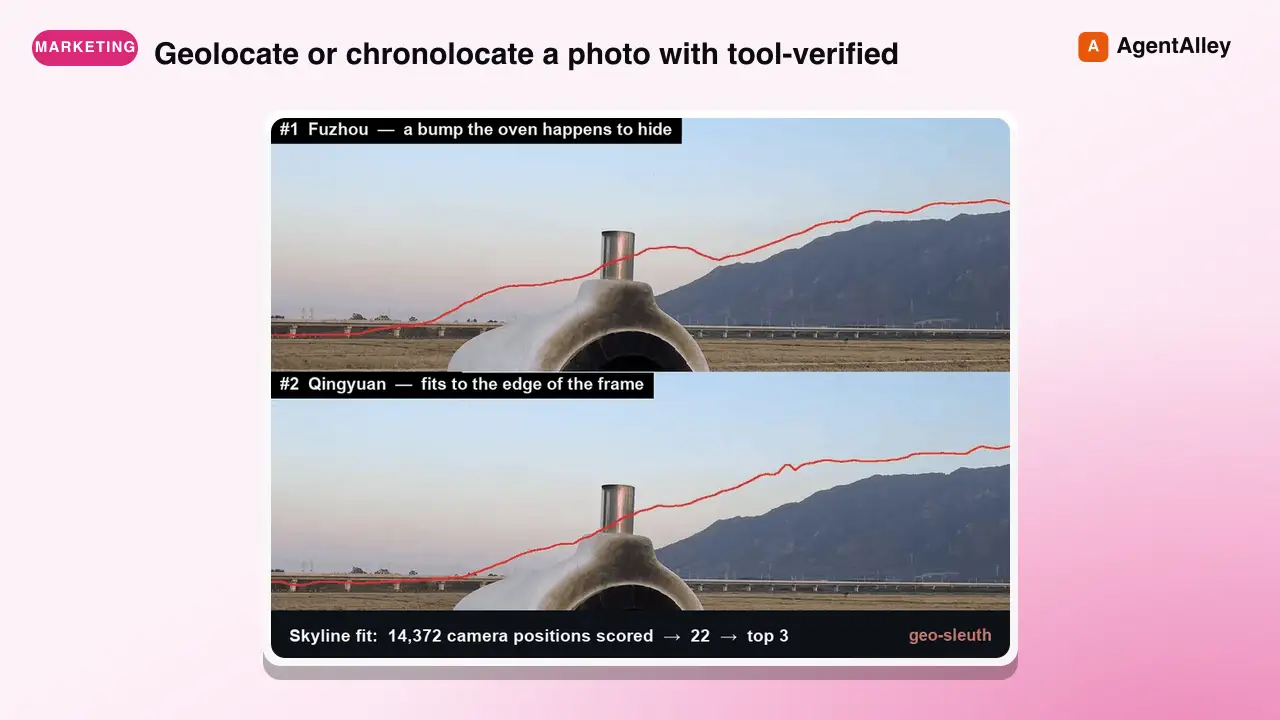
 Oldcircle/geo-sleuth · by OldcircleGeolocate or chronolocate a photo with tool-verified reasoning (where was this taken / when was it taken / photo geolocation / geo-guessing). Given one or more photos, intake.py does metadata, OCR and reverse image search (Baidu/Yandex) in one command; clues and candidates go on a candidate board (board.py) that ranks them and gives the next step; clues.py looks up calling codes, driving side, plates and area codes from region packs; for satellite and street view the machine ranks first and you look only at the top few (CLIP in sat_scan.py, DINOv2+SIFT in match.py); plus sun and shadow math, OSM Overpass and DEM skylines. Every conclusion is checked against real data; output is coordinates + error radius, evidence images and tiered confidence. Use when the user shares a photo and asks where was this taken / geolocate this / when was this taken / 这是哪 / 在哪拍的 / 帮我定位这张照片 / 网络迷踪 / 图寻 / 几点拍的.★ 3.4k GitHub stars
 SkillAI Engine Visibility Tracker
 Ryze-AI-Adgent/open-seo-mcp-skills · by Ryze-AI-AdgentMeasure real AI-engine visibility — traffic from ChatGPT, Perplexity, Claude, Gemini and which pages they cite — from actual GA4 referral data, not prompt sampling. Use when asked "AI visibility", "GEO/AEO check", "do LLMs cite us", "traffic from ChatGPT", or "how do we show up in AI search".★ 3.1k GitHub stars
 SkillAI Citation Readiness StrategyAgriciDaniel/claude-blog · by AgriciDanielUse GEO and AEO as legacy labels for AI citation readiness. For Google, the★ 2.2k GitHub stars
 SkillMulti-Channel SEO Operator
 leopard627/fire-your-seo-agency · by leopard627SEO·AEO·GEO·LLMO·NEO(네이버) 다섯 레인을 진단하고 직접 구현하며, 인용되는 콘텐츠를 계속 생산하는 서브 블로그·콘텐츠 운영 파이프라인까지 세팅하는 스킬. 사이트를 검색엔진·답변엔진·생성 AI·네이버 AI 브리핑이 인용하는 1차 소스로 만든다. "SEO 해줘", "AI에 인용되게 해줘", "네이버 노출 늘려줘", "llms.txt 만들어줘", "블로그 만들어줘/글 써줘", "콘텐츠 백로그·캘린더 잡아줘", "낡은 글 갱신해줘" 류 요청에 사용. Use for "audit my site's SEO", "get my site cited by ChatGPT/Perplexity/AI Overviews", "improve search visibility", "create llms.txt", "answer engine / generative engine optimization", "set up a blog that gets cited", "content backlog / calendar / refresh", and any AI-search-visibility request.★ 716 GitHub stars
 SkillSEO and GEO Auditor
 dageno-agents/seo-geo-audit · by dageno-agentsRun a unified SEO and GEO audit for a website, page, or domain. Use when the user asks for a full SEO audit, GEO audit, AI visibility review, EEAT review, entity audit, authority audit, or wants one prioritized report that combines technical findings, content quality, trust signals, and AI citation readiness.★ 175 GitHub stars
More from LeadMagic
 SkillFirst-Party Analytics Setup
 LeadMagic/gtm-skills · by LeadMagicSet up first-party tracking and analytics — website pixels, conversion tracking, UTM architecture, cookie consent, server-side tagging vs client-side, 1P vs 3P data strategy, and identity resolution. Use when setting up tracking, implementing pixels, building attribution, or preparing for privacy-first measurement. Triggers on: "pixel", "tracking", "conversion tracking", "first-party data", server-side tagging", "UTM", "cookie consent", "1P vs 3P", "identity resolution", or any tracking implementation request.★ 62 GitHub stars
 SkillStrategic Account MarketingLeadMagic/gtm-skills · by LeadMagicRuns strategic 1-to-1 ABM for 5-15 high-value accounts: account plans, custom microsites, executive engagement, direct mail, and board-level connections. Use when a named enterprise account justifies bespoke content and executive time, or when the user needs a strategic account plan. Triggers on: "1-to-1 ABM", "strategic ABM", "custom ABM", "key account marketing", "named account".★ 62 GitHub stars
 SkillCluster Account MarketingLeadMagic/gtm-skills · by LeadMagicRuns ABM at scale (1-to-few) for 15-50 clustered accounts: industry or persona clusters, semi-custom campaigns, and cluster-level content. Use when named-account ABM needs to reach more accounts without bespoke work per account. Triggers on: "1-to-few ABM", "ABM scale", "cluster ABM", "industry ABM".★ 62 GitHub stars
 SkillProgrammatic Account TargetingLeadMagic/gtm-skills · by LeadMagicRuns programmatic 1-to-many ABM for 50-200+ accounts: automated personalization, scaled outbound, intent-based targeting, and lookalike expansion. Use when ABM coverage must grow without adding headcount or when the user wants automated account-based outreach. Triggers on: "1-to-many ABM", programmatic ABM", "scaled ABM", "automated ABM".★ 62 GitHub stars
 SkillAccount Strategy DesignerLeadMagic/gtm-skills · by LeadMagicDesigns an account-based marketing program: tier selection, account scoring, channel orchestration, BDR alignment (account-based sales development), and a measurement framework. Use when the user is launching or redesigning ABM, choosing between 1-to-1, 1-to-few, and 1-to-many, or building a target account program. Triggers on: "ABM strategy", "account based marketing", "ABM playbook", "design ABM", "target accounts", "ABSD", "account based sales development", "Lars Nilsson".★ 62 GitHub stars
 SkillTarget Account SelectorLeadMagic/gtm-skills · by LeadMagicBuilds and tiers a target account list: fit and intent scoring models, tier assignment, and TAM segmentation. Use when the user needs to decide which accounts to target, score or tier an account list, or prioritize a TAM for ABM or outbound. Triggers on: "account selection", "target account list", "tier accounts", "prioritize accounts", "TAM segmentation".★ 62 GitHub stars