AI Search Visibility Optimizer
Generative engine optimization
When the user wants to optimize for AI search visibility (ChatGPT, Claude, Perplexity, AI Overviews). Also use when the user mentions "GEO," "AEO," "generative engine optimization," "AI search visibility," "LLM optimization," "GitHub…
---
name: generative-engine-optimization
description: When the user wants to optimize for AI search visibility (ChatGPT, Claude, Perplexity, AI Overviews). Also use when the user mentions "GEO," "AEO," "generative engine optimization," "AI search visibility," "LLM optimization," "GitHub GEO," "Grokipedia," "optimize for ChatGPT," "AI Overviews," "Bing Copilot," "Yandex AI," "Perplexity optimization," "GEO strategy," or "AI search optimization." For third-party publishing strategy (which platforms to use), use parasite-seo. For GitHub repos, README, and Awesome lists, use github. For Medium.com only, use medium-posts. For Grokipedia edits, use grokipedia-recommendations. For traditional Google SERP strategy, use seo-strategy.
metadata:
  version: 1.4.0
---

# Strategies: GEO (Generative Engine Optimization)

Guides GEO/AEO strategy for AI search visibility. GEO optimizes content for ChatGPT, Claude, Perplexity, and AI search summaries (Google AI Overviews, Bing Copilot, Yandex Search with AI)—getting cited in AI-generated answers rather than ranking in traditional SERPs. See **serp-features** for AI search as SERP features; **featured-snippet** for snippet optimization that overlaps with AI Overviews.

**When invoking**: On **first use**, if helpful, open with 1-2 sentences on what this skill covers and why it matters, then provide the main output. On **subsequent use** or when the user asks to skip, go directly to the main output.

## Scope

- **GEO** = Generative Engine Optimization
- **AEO** = Answer Engine Optimization
- **LLMO** = Large Language Model Optimization
Overview
Guides GEO/AEO strategy for AI search visibility. GEO optimizes content for ChatGPT, Claude, Perplexity, and AI search summaries (Google AI Overviews, Bing Copilot, Yandex Search with AI)—getting cited in AI-generated answers rather than ranking in traditional SERPs. See serp-features for AI search as SERP features; featured-snippet for snippet optimization that overlaps with AI Overviews.
What you get
- Content structurefor AI citation
- Entityoptimization; see entity-seo
- Distributionstrategy
- Measurementapproach
Manual install (npx, ZIP)
npx skills add kostja94/marketing-skills --skill generative-engine-optimization -g -a claude-codenpx degit kostja94/marketing-skills/skills/strategies/commercial/geo#main ~/.claude/skills/generative-engine-optimizationConnects with Agent Alley MCP · agentalley.io/mcp
Files included
SKILL.md11.4 KB
Read SKILL.md here
Show the full text151 lines
Strategies: GEO (Generative Engine Optimization)
Guides GEO/AEO strategy for AI search visibility. GEO optimizes content for ChatGPT, Claude, Perplexity, and AI search summaries (Google AI Overviews, Bing Copilot, Yandex Search with AI)—getting cited in AI-generated answers rather than ranking in traditional SERPs. See serp-features for AI search as SERP features; featured-snippet for snippet optimization that overlaps with AI Overviews.
When invoking: On first use, if helpful, open with 1-2 sentences on what this skill covers and why it matters, then provide the main output. On subsequent use or when the user asks to skip, go directly to the main output.
Scope
- GEO = Generative Engine Optimization
- AEO = Answer Engine Optimization
- LLMO = Large Language Model Optimization
- AIO = Artificial Intelligence Optimization
All refer to the same goal: visibility in AI assistant responses.
GEO vs. SEO
| Dimension | SEO | GEO |
|---|---|---|
| Goal | Rankings in search results | Citations in AI answers |
| User path | Click → visit → convert | Answer in-place; may not visit |
| Content | Full page optimization | Clear, citable paragraphs |
| Metrics | Clicks, traffic | Citations, brand mentions |
| Platforms | Google, Bing, Yandex (organic) | AI Overviews, Copilot, Yandex AI, ChatGPT, Perplexity |
Both matter: Create content that ranks and gets cited. AI search summaries (AI Overviews, Copilot, Yandex AI) are SERP features—see serp-features. When SERP features cause zero-click (user gets answer without clicking), citation becomes the primary value; optimize for being cited, not just ranked.
AI Search Platforms (SERP Features + Standalone)
| Platform | Type | Source Selection | Optimization Focus |
|---|---|---|---|
| Google AI Overviews | SERP feature | Top 10–12 organic; Gemini; favors older domains (49% over 15 yrs) | Traditional SEO; structured data; citable blocks |
| Bing Copilot Search | SERP feature | Bing index; GPT-4; 9.81% domain overlap with Google; favors younger domains (18.85%); LinkedIn signals for B2B | Bing optimization; LinkedIn presence; structured content |
| Yandex Search with AI / Neuro | SERP feature | Real-time Yandex search; YandexGPT; Russia-focused | Yandex indexing; Russian content; cited sources |
| Perplexity | Standalone | 200B+ URL index; independent crawl; favors recency, semantic alignment | Content freshness; semantic markup; mid-tier site opportunity |
| ChatGPT (web search) | Standalone | GPTbot; high-authority, frequently updated, LLM-friendly; favors older domains (45.8%) | Backlinks; structured data; authority signals |
Citation behavior: AI Overview citations 20–35% higher CTR than equivalent organic. Copilot: shortest responses, fewest links (~3.13/response). Perplexity: prominent URL citations, high trackability. Geneo, GEO AIO
Platform traffic context: Among standalone AI tools, ChatGPT captures ~60%+ of independent Gen AI traffic, Gemini ~20%+, while Claude, Perplexity, and Grok each account for ~2-4%+. These tools reach users directly. SERP features (AI Overviews, Copilot) reach users through existing search flows rather than as independent destinations. Prioritize optimization effort proportionally.
How GEO Works (RAG & Search Supply)
GEO operates through RAG (Retrieval-Augmented Generation)—AI tools retrieve content first, then generate answers. The retrieval supply type varies by platform and determines which content surfaces for citation.
Retrieval Supply Types
| Type | Description | Platforms |
|---|---|---|
| Self-built index | Platform maintains its own crawl and search index | Perplexity (200B+ URL index, PerplexityBot); ChatGPT (OAI-SearchBot index) |
| Bound search engine | Platform uses a fixed first-party search API | Copilot (Bing); Google AI Overviews / AI Mode (Google Search + query fan-out) |
| Third-party API | Platform contracts a third-party search API | Claude for Government (Brave Search API); smaller AI tools using Tavily, Exa, You.com |
| Hybrid | Combination of self-built + external API | ChatGPT (OAI-SearchBot + possible search partners); Claude Web Search (supplier not publicly disclosed) |
Platform Retrieval & Implications
| Platform | Primary Supply | Strategic Implication |
|---|---|---|
| Google AI Overviews / AI Mode | Google Search (query fan-out) | Strong traditional SEO + structured data is the most reliable path |
| Bing Copilot | Bing index | Requires Bing indexing; LinkedIn signals for B2B visibility |
| ChatGPT (web search) | OAI-SearchBot + partners | High-authority, frequently updated content favored; backlinks matter |
| Perplexity | Proprietary crawl | Content freshness; semantic alignment; mid-tier sites have opportunity |
| Claude (web search) | Not publicly disclosed | Focus on general crawlability and clear structured content |
Third-party search APIs (Tavily, Exa, You.com, Brave Search API) feed smaller AI tools and custom agents. Content that is crawlable and indexed via standard web search reaches these APIs through their supply indexes. Core model training (long, costly, not widely actionable): focus on RAG optimization.
AI Crawlers & Discovery
AI crawlers fall into three categories with different implications for content strategy:
| Type | Purpose | Examples | Implication |
|---|---|---|---|
| Training crawlers | Gather data for model training | GPTBot, ClaudeBot, Google-Extended, Meta crawlers | Blocking via robots.txt prevents training data use; does not affect real-time search/retrieval by the same provider |
| Index/RAG crawlers | Build search index for retrieval | OAI-SearchBot, PerplexityBot, Claude-SearchBot, Bytespider (Cohere), AppleBot | Must allow for RAG-based AI citation; critical for GEO |
| Real-time crawlers | Fetch content on-demand at query time | ChatGPT-User (opt-in via web search) | Content must be accessible without a login; paywalls may block citation |
Content discovery: "Push" submissions for general web content are primarily supported through Bing IndexNow. Google's Indexing API is limited to JobPosting and BroadcastEvent pages only (not general content). OpenAI, Anthropic, Perplexity, xAI, Meta, and DeepSeek do not offer public submission portals—their crawlers discover content through standard crawl and sitemaps only.
AI crawlers generally do not execute JavaScript—critical content must be in initial HTML. See rendering-strategies for SSR, SSG, CSR; site-crawlability for AI crawler optimization; robots-txt for allow/block decisions. Vercel/MERJ study (2024)
Content Best Practices
| Practice | Purpose |
|---|---|
| Direct-answer format | Answer specific questions in clear paragraphs |
| Entity signals | Clear brand, product, author identity; see entity-seo |
| Citable paragraphs | Each block understandable on its own |
| Distribution | Website, YouTube (Google prioritizes YouTube in search; ~78% of social media citations in AI Overviews come from YouTube + Reddit), forums, Reddit—thoughtful comments can outrank blog posts |
Article-Level GEO
For blog posts and articles, structure content for AI citation. Studies find content with TL;DR, structured formats, and clear answers is cited substantially more by AI engines.
| Element | Guideline |
|---|---|
| TL;DR or Key Takeaways | Choose one: TL;DR = 50–100 word bold summary paragraph; Key Takeaways = 5–7 bullet points; placed after intro |
| QAE pattern | Question (H2) → Answer (2 sentences) → Evidence (data, examples, lists) |
| Answer-first | Direct answer in first 40–60 words after each H2 |
| Answer blocks | 100–200 words per section; direct answer + context + evidence + nuance |
| Structured formats | Lists, tables, numbered steps increase citation rate |
See article-content for content creation; article-page-generator for page structure.
Parasite SEO & High-Authority Platforms
Parasite SEO = Placing content on high-authority platforms to leverage their domain strength for rankings and AI citation. See parasite-seo for full strategy.
GitHub: Tier 2 technical authority; very high AI citation. See github for repos, README, Pages, gists, awesome lists.
YouTube: Google prioritizes YouTube in search; YouTube citations in AI Overviews surged 25.21%. Long-form instructional and visual-demo videos dominate. See youtube-seo for channel and video optimization; video-optimization for website-embedded video SEO.
Grokipedia: xAI's AI encyclopedia; ChatGPT, Perplexity, Copilot cite it. See grokipedia-recommendations for adding recommendations or links. Contribute genuinely useful content; avoid manipulative placement (Google Site Reputation Abuse policy).
Tools
- GEO tracking and optimization tools for measuring AI citation and visibility
Key Insight
ChatGPT traffic converts at significantly higher rates than Google search—studies report 2x to 9x uplift depending on industry. AI tool users often have clearer intent, but results vary by vertical.
Output Format
- Content structure for AI citation
- Entity optimization; see entity-seo
- Distribution strategy
- Measurement approach
Related Skills
- site-crawlability: AI crawler optimization; URL/redirect management
- rendering-strategies: SSR, SSG, CSR; content in initial HTML for AI crawlers
- robots-txt: AI crawler allow/block (GPTBot, ClaudeBot, PerplexityBot)
- parasite-seo: Parasite SEO strategy; high-authority platforms for GEO
- github: GitHub for GEO; repos, README; Tier 2 technical authority
- youtube-seo: YouTube optimization; GEO distribution; Google prioritizes YouTube
- serp-features: Strongly related—AI Overviews, Bing Copilot, Yandex AI; platform comparison
- featured-snippet: Snippet optimization; overlaps with AI Overviews
- entity-seo: Entity signals; Organization, Person schema; GEO citation
- article-content: Article body creation; TL;DR, Key Takeaways, QAE pattern
- article-page-generator: Article page structure; schema; layout
- faq-page-generator: FAQ structure for GEO; citable Q&A blocks; content in initial HTML
- howto-section-generator: HowTo step sections; citable ordered procedures; HowTo JSON-LD
| 1 | |
| 2 | name generative-engine-optimization |
| 3 | description When the user wants to optimize for AI search visibility (ChatGPT, Claude, Perplexity, AI Overviews). Also use when the user mentions "GEO," "AEO," "generative engine optimization," "AI search visibility," "LLM optimization," "GitHub GEO," "Grokipedia," "optimize for ChatGPT," "AI Overviews," "Bing Copilot," "Yandex AI," "Perplexity optimization," "GEO strategy," or "AI search optimization." For third-party publishing strategy (which platforms to use), use parasite-seo. For GitHub repos, README, and Awesome lists, use github. For Medium.com only, use medium-posts. For Grokipedia edits, use grokipedia-recommendations. For traditional Google SERP strategy, use seo-strategy. |
| 4 | metadata |
| 5 | version 1.4.0 |
| 6 | |
| 7 | |
| 8 | # Strategies: GEO (Generative Engine Optimization) |
| 9 | |
| 10 | Guides GEO/AEO strategy for AI search visibility. GEO optimizes content for ChatGPT, Claude, Perplexity, and AI search summaries (Google AI Overviews, Bing Copilot, Yandex Search with AI)—getting cited in AI-generated answers rather than ranking in traditional SERPs. See **serp-features** for AI search as SERP features; **featured-snippet** for snippet optimization that overlaps with AI Overviews. |
| 11 | |
| 12 | **When invoking**: On **first use**, if helpful, open with 1-2 sentences on what this skill covers and why it matters, then provide the main output. On **subsequent use** or when the user asks to skip, go directly to the main output. |
| 13 | |
| 14 | ## Scope |
| 15 | |
| 16 | **GEO** = Generative Engine Optimization |
| 17 | **AEO** = Answer Engine Optimization |
| 18 | **LLMO** = Large Language Model Optimization |
| 19 | **AIO** = Artificial Intelligence Optimization |
| 20 | |
| 21 | All refer to the same goal: visibility in AI assistant responses. |
| 22 | |
| 23 | ## GEO vs. SEO |
| 24 | |
| 25 | | Dimension | SEO | GEO | |
| 26 | |-----------|-----|-----| |
| 27 | | **Goal** | Rankings in search results | Citations in AI answers | |
| 28 | | **User path** | Click → visit → convert | Answer in-place; may not visit | |
| 29 | | **Content** | Full page optimization | Clear, citable paragraphs | |
| 30 | | **Metrics** | Clicks, traffic | Citations, brand mentions | |
| 31 | | **Platforms** | Google, Bing, Yandex (organic) | AI Overviews, Copilot, Yandex AI, ChatGPT, Perplexity | |
| 32 | |
| 33 | **Both matter**: Create content that ranks and gets cited. AI search summaries (AI Overviews, Copilot, Yandex AI) are **SERP features**—see **serp-features**. When SERP features cause **zero-click** (user gets answer without clicking), citation becomes the primary value; optimize for being cited, not just ranked. |
| 34 | |
| 35 | ## AI Search Platforms (SERP Features + Standalone) |
| 36 | |
| 37 | | Platform | Type | Source Selection | Optimization Focus | |
| 38 | |----------|------|------------------|---------------------| |
| 39 | | **Google AI Overviews** | SERP feature | Top 10–12 organic; Gemini; favors older domains (49% over 15 yrs) | Traditional SEO; structured data; citable blocks | |
| 40 | | **Bing Copilot Search** | SERP feature | Bing index; GPT-4; 9.81% domain overlap with Google; favors younger domains (18.85%); LinkedIn signals for B2B | Bing optimization; LinkedIn presence; structured content | |
| 41 | | **Yandex Search with AI / Neuro** | SERP feature | Real-time Yandex search; YandexGPT; Russia-focused | Yandex indexing; Russian content; cited sources | |
| 42 | | **Perplexity** | Standalone | 200B+ URL index; independent crawl; favors recency, semantic alignment | Content freshness; semantic markup; mid-tier site opportunity | |
| 43 | | **ChatGPT (web search)** | Standalone | GPTbot; high-authority, frequently updated, LLM-friendly; favors older domains (45.8%) | Backlinks; structured data; authority signals | |
| 44 | |
| 45 | **Citation behavior**: AI Overview citations 20–35% higher CTR than equivalent organic. Copilot: shortest responses, fewest links (~3.13/response). Perplexity: prominent URL citations, high trackability. [Geneo], [GEO AIO] |
| 46 | |
| 47 | **Platform traffic context**: Among standalone AI tools, ChatGPT captures ~60%+ of independent Gen AI traffic, Gemini ~20%+, while Claude, Perplexity, and Grok each account for ~2-4%+. These tools reach users directly. SERP features (AI Overviews, Copilot) reach users through existing search flows rather than as independent destinations. Prioritize optimization effort proportionally. |
| 48 | |
| 49 | ## How GEO Works (RAG & Search Supply) |
| 50 | |
| 51 | GEO operates through **RAG (Retrieval-Augmented Generation)**—AI tools retrieve content first, then generate answers. The retrieval supply type varies by platform and determines which content surfaces for citation. |
| 52 | |
| 53 | ### Retrieval Supply Types |
| 54 | |
| 55 | | Type | Description | Platforms | |
| 56 | |------|------------|-----------| |
| 57 | | **Self-built index** | Platform maintains its own crawl and search index | Perplexity (200B+ URL index, PerplexityBot); ChatGPT (OAI-SearchBot index) | |
| 58 | | **Bound search engine** | Platform uses a fixed first-party search API | Copilot (Bing); Google AI Overviews / AI Mode (Google Search + query fan-out) | |
| 59 | | **Third-party API** | Platform contracts a third-party search API | Claude for Government (Brave Search API); smaller AI tools using Tavily, Exa, You.com | |
| 60 | | **Hybrid** | Combination of self-built + external API | ChatGPT (OAI-SearchBot + possible search partners); Claude Web Search (supplier not publicly disclosed) | |
| 61 | |
| 62 | ### Platform Retrieval & Implications |
| 63 | |
| 64 | | Platform | Primary Supply | Strategic Implication | |
| 65 | |----------|---------------|----------------------| |
| 66 | | **Google AI Overviews / AI Mode** | Google Search (query fan-out) | Strong traditional SEO + structured data is the most reliable path | |
| 67 | | **Bing Copilot** | Bing index | Requires Bing indexing; LinkedIn signals for B2B visibility | |
| 68 | | **ChatGPT (web search)** | OAI-SearchBot + partners | High-authority, frequently updated content favored; backlinks matter | |
| 69 | | **Perplexity** | Proprietary crawl | Content freshness; semantic alignment; mid-tier sites have opportunity | |
| 70 | | **Claude (web search)** | Not publicly disclosed | Focus on general crawlability and clear structured content | |
| 71 | |
| 72 | **Third-party search APIs** (Tavily, Exa, You.com, Brave Search API) feed smaller AI tools and custom agents. Content that is crawlable and indexed via standard web search reaches these APIs through their supply indexes. **Core model training** (long, costly, not widely actionable): focus on RAG optimization. |
| 73 | |
| 74 | ## AI Crawlers & Discovery |
| 75 | |
| 76 | AI crawlers fall into three categories with different implications for content strategy: |
| 77 | |
| 78 | | Type | Purpose | Examples | Implication | |
| 79 | |------|---------|---------|-------------| |
| 80 | | **Training crawlers** | Gather data for model training | GPTBot, ClaudeBot, Google-Extended, Meta crawlers | Blocking via robots.txt prevents training data use; **does not** affect real-time search/retrieval by the same provider | |
| 81 | | **Index/RAG crawlers** | Build search index for retrieval | OAI-SearchBot, PerplexityBot, Claude-SearchBot, Bytespider (Cohere), AppleBot | **Must allow** for RAG-based AI citation; critical for GEO | |
| 82 | | **Real-time crawlers** | Fetch content on-demand at query time | ChatGPT-User (opt-in via web search) | Content must be accessible without a login; paywalls may block citation | |
| 83 | |
| 84 | **Content discovery**: "Push" submissions for general web content are primarily supported through Bing IndexNow. Google's Indexing API is limited to JobPosting and BroadcastEvent pages only (not general content). OpenAI, Anthropic, Perplexity, xAI, Meta, and DeepSeek do **not** offer public submission portals—their crawlers discover content through standard crawl and sitemaps only. |
| 85 | |
| 86 | AI crawlers generally do **not** execute JavaScript—critical content must be in initial HTML. See **rendering-strategies** for SSR, SSG, CSR; **site-crawlability** for AI crawler optimization; **robots-txt** for allow/block decisions. [Vercel/MERJ study] (2024) |
| 87 | |
| 88 | ## Content Best Practices |
| 89 | |
| 90 | | Practice | Purpose | |
| 91 | |----------|---------| |
| 92 | | **Direct-answer format** | Answer specific questions in clear paragraphs | |
| 93 | | **Entity signals** | Clear brand, product, author identity; see **entity-seo** | |
| 94 | | **Citable paragraphs** | Each block understandable on its own | |
| 95 | | **Distribution** | Website, **YouTube** (Google prioritizes YouTube in search; ~78% of social media citations in AI Overviews come from YouTube + Reddit), forums, Reddit—thoughtful comments can outrank blog posts | |
| 96 | |
| 97 | ### Article-Level GEO |
| 98 | |
| 99 | For blog posts and articles, structure content for AI citation. Studies find content with TL;DR, structured formats, and clear answers is cited substantially more by AI engines. |
| 100 | |
| 101 | | Element | Guideline | |
| 102 | |---------|-----------| |
| 103 | | **TL;DR or Key Takeaways** | Choose one: **TL;DR** = 50–100 word bold summary paragraph; **Key Takeaways** = 5–7 bullet points; placed after intro | |
| 104 | | **QAE pattern** | Question (H2) → Answer (2 sentences) → Evidence (data, examples, lists) | |
| 105 | | **Answer-first** | Direct answer in first 40–60 words after each H2 | |
| 106 | | **Answer blocks** | 100–200 words per section; direct answer + context + evidence + nuance | |
| 107 | | **Structured formats** | Lists, tables, numbered steps increase citation rate | |
| 108 | |
| 109 | See **article-content** for content creation; **article-page-generator** for page structure. |
| 110 | |
| 111 | ## Parasite SEO & High-Authority Platforms |
| 112 | |
| 113 | **Parasite SEO** = Placing content on high-authority platforms to leverage their domain strength for rankings and AI citation. See **parasite-seo** for full strategy. |
| 114 | |
| 115 | **GitHub**: Tier 2 technical authority; very high AI citation. See **github** for repos, README, Pages, gists, awesome lists. |
| 116 | |
| 117 | **YouTube**: Google prioritizes YouTube in search; YouTube citations in AI Overviews surged 25.21%. Long-form instructional and visual-demo videos dominate. See **youtube-seo** for channel and video optimization; **video-optimization** for website-embedded video SEO. |
| 118 | |
| 119 | **Grokipedia**: xAI's AI encyclopedia; ChatGPT, Perplexity, Copilot cite it. See **grokipedia-recommendations** for adding recommendations or links. Contribute genuinely useful content; avoid manipulative placement (Google Site Reputation Abuse policy). |
| 120 | |
| 121 | ## Tools |
| 122 | |
| 123 | GEO tracking and optimization tools for measuring AI citation and visibility |
| 124 | |
| 125 | ## Key Insight |
| 126 | |
| 127 | ChatGPT traffic converts at significantly higher rates than Google search—studies report 2x to 9x uplift depending on industry. AI tool users often have clearer intent, but results vary by vertical. |
| 128 | |
| 129 | ## Output Format |
| 130 | |
| 131 | **Content structure** for AI citation |
| 132 | **Entity** optimization; see **entity-seo** |
| 133 | **Distribution** strategy |
| 134 | **Measurement** approach |
| 135 | |
| 136 | ## Related Skills |
| 137 | |
| 138 | **site-crawlability**: AI crawler optimization; URL/redirect management |
| 139 | **rendering-strategies**: SSR, SSG, CSR; content in initial HTML for AI crawlers |
| 140 | **robots-txt**: AI crawler allow/block (GPTBot, ClaudeBot, PerplexityBot) |
| 141 | **parasite-seo**: Parasite SEO strategy; high-authority platforms for GEO |
| 142 | **github**: GitHub for GEO; repos, README; Tier 2 technical authority |
| 143 | **youtube-seo**: YouTube optimization; GEO distribution; Google prioritizes YouTube |
| 144 | **serp-features**: **Strongly related**—AI Overviews, Bing Copilot, Yandex AI; platform comparison |
| 145 | **featured-snippet**: Snippet optimization; overlaps with AI Overviews |
| 146 | **entity-seo**: Entity signals; Organization, Person schema; GEO citation |
| 147 | **article-content**: Article body creation; TL;DR, Key Takeaways, QAE pattern |
| 148 | **article-page-generator**: Article page structure; schema; layout |
| 149 | **faq-page-generator**: FAQ structure for GEO; citable Q&A blocks; content in initial HTML |
| 150 | **howto-section-generator**: HowTo step sections; citable ordered procedures; HowTo JSON-LD |
| 151 |
Details
- License
- MIT
- Stars on the repo
- ★ 1,006
- Checked
- Source
- kostja94/marketing-skills ↗
- Creator
- kostja94 · 106 listings
Similar skills
See all → SkillAI Search Optimization
 AgriciDaniel/claude-seo · by AgriciDanielOptimize content for AI Overviews (formerly SGE), ChatGPT web search, Perplexity, and other AI-powered search experiences. Generative Engine Optimization (GEO) analysis including brand mention signals, AI crawler accessibility, llms.txt compliance, passage-level citability scoring, and platform-specific optimization. Use when user says "AI Overviews", "SGE", GEO", "AI search", "LLM optimization", "Perplexity", "AI citations", ChatGPT search", or "AI visibility".★ 17.4k GitHub stars
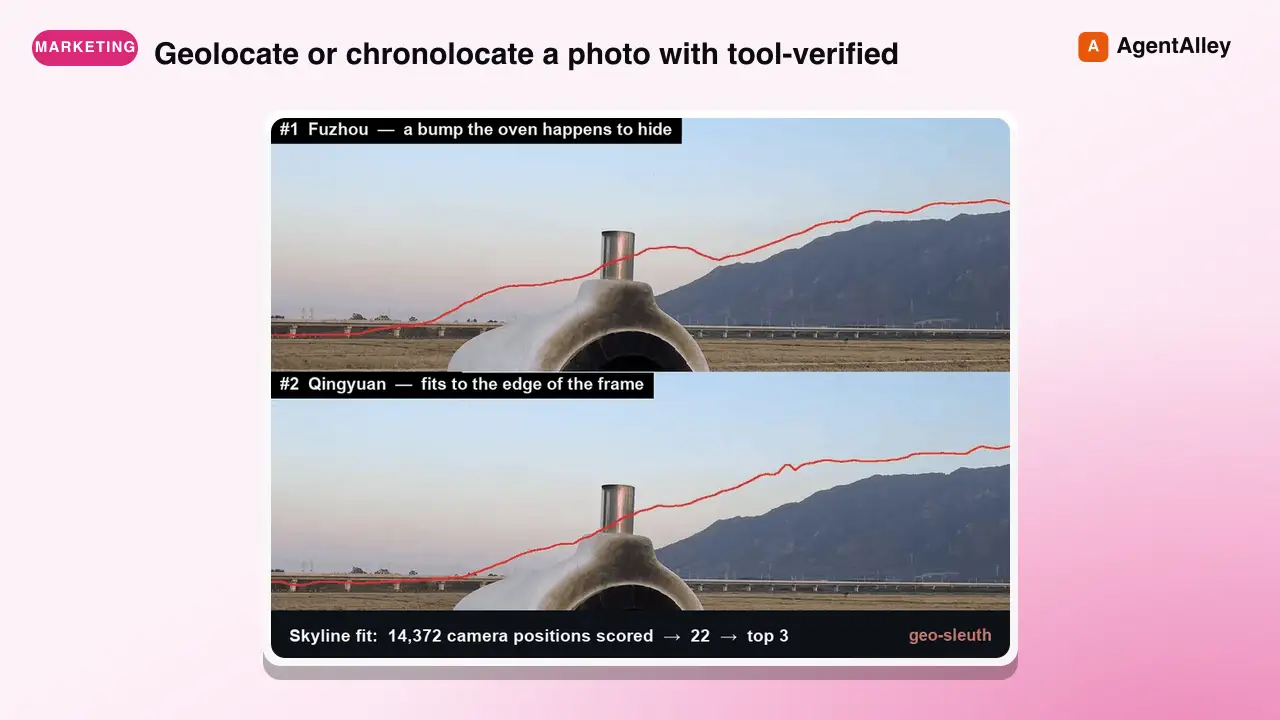 SkillPhoto Geolocation Analyzer
 Oldcircle/geo-sleuth · by OldcircleGeolocate or chronolocate a photo with tool-verified reasoning (where was this taken / when was it taken / photo geolocation / geo-guessing). Given one or more photos, intake.py does metadata, OCR and reverse image search (Baidu/Yandex) in one command; clues and candidates go on a candidate board (board.py) that ranks them and gives the next step; clues.py looks up calling codes, driving side, plates and area codes from region packs; for satellite and street view the machine ranks first and you look only at the top few (CLIP in sat_scan.py, DINOv2+SIFT in match.py); plus sun and shadow math, OSM Overpass and DEM skylines. Every conclusion is checked against real data; output is coordinates + error radius, evidence images and tiered confidence. Use when the user shares a photo and asks where was this taken / geolocate this / when was this taken / 这是哪 / 在哪拍的 / 帮我定位这张照片 / 网络迷踪 / 图寻 / 几点拍的.★ 3.4k GitHub stars
 SkillAI Engine Visibility Tracker
 Ryze-AI-Adgent/open-seo-mcp-skills · by Ryze-AI-AdgentMeasure real AI-engine visibility — traffic from ChatGPT, Perplexity, Claude, Gemini and which pages they cite — from actual GA4 referral data, not prompt sampling. Use when asked "AI visibility", "GEO/AEO check", "do LLMs cite us", "traffic from ChatGPT", or "how do we show up in AI search".★ 3.1k GitHub stars
 SkillAI Citation Readiness StrategyAgriciDaniel/claude-blog · by AgriciDanielUse GEO and AEO as legacy labels for AI citation readiness. For Google, the★ 2.2k GitHub stars
 SkillMulti-Channel SEO Operator
 leopard627/fire-your-seo-agency · by leopard627SEO·AEO·GEO·LLMO·NEO(네이버) 다섯 레인을 진단하고 직접 구현하며, 인용되는 콘텐츠를 계속 생산하는 서브 블로그·콘텐츠 운영 파이프라인까지 세팅하는 스킬. 사이트를 검색엔진·답변엔진·생성 AI·네이버 AI 브리핑이 인용하는 1차 소스로 만든다. "SEO 해줘", "AI에 인용되게 해줘", "네이버 노출 늘려줘", "llms.txt 만들어줘", "블로그 만들어줘/글 써줘", "콘텐츠 백로그·캘린더 잡아줘", "낡은 글 갱신해줘" 류 요청에 사용. Use for "audit my site's SEO", "get my site cited by ChatGPT/Perplexity/AI Overviews", "improve search visibility", "create llms.txt", "answer engine / generative engine optimization", "set up a blog that gets cited", "content backlog / calendar / refresh", and any AI-search-visibility request.★ 716 GitHub stars
 SkillSEO and GEO Auditor
 dageno-agents/seo-geo-audit · by dageno-agentsRun a unified SEO and GEO audit for a website, page, or domain. Use when the user asks for a full SEO audit, GEO audit, AI visibility review, EEAT review, entity audit, authority audit, or wants one prioritized report that combines technical findings, content quality, trust signals, and AI citation readiness.★ 175 GitHub stars
More from kostja94
 SkillAffiliate Marketing Strategy
 kostja94/marketing-skills · by kostja94When the user wants to plan, implement, or optimize affiliate marketing strategy. Also use when the user mentions "affiliate marketing," "affiliate program strategy," "CPS model," "affiliate recruitment," "commission structure," "affiliate partners," "affiliate network," "affiliate tracking," "affiliate commission," or "partner marketing." For affiliate page, use affiliate-page-generator.★ 1k GitHub stars
 SkillAI Search Traffic Trackerkostja94/marketing-skills · by kostja94When the user wants to track AI search traffic in GA4 or GSC. Also use when the user mentions "AI traffic," "ChatGPT referral," "Perplexity traffic," "AI Overviews," "GA4 AI sources," "AI search analytics," "track AI referrals," "AI search traffic," "Claude traffic," or "how to track AI traffic." For AI SEO strategy, use generative-engine-optimization.★ 1k GitHub stars
 SkillGA4 Analytics Optimizerkostja94/marketing-skills · by kostja94When the user wants to set up, audit, or optimize analytics tracking (GA4, events, conversions). Also use when the user mentions "Google Analytics," "GA4," "event tracking," "conversions," "attribution model," "gtag," "data layer," "GA4 setup," "conversion tracking," "event setup," "User ID tracking," or "CTA attribution." For traffic insights, use traffic-analysis.★ 1k GitHub stars
 SkillMobile App Campaign Managerkostja94/marketing-skills · by kostja94When the user wants to run app install ads, user acquisition (UA), or promote mobile apps. Also use when the user mentions "app ads," "app install ads," "UA," "user acquisition," "Google App Campaigns," "Apple Search Ads," "ASA," "UAC," "App Store ads," "Play Store ads," "CPI," or "app promotion." For store listings, use distribution-channels.★ 1k GitHub stars
 SkillLong-Form Article Writerkostja94/marketing-skills · by kostja94When the user wants to write, generate, or create article body content—blog post body, long-form content, how-to guide, listicle. Also use when the user mentions "write article," "article content," "blog post content," "article body," "long-form content creation," "generate article," "article draft," "how-to guide content," "listicle content," "information gain," or "content density." For single post page structure, schema, and SEO metadata, use article-page-generator. For blog index/listing page, use blog-page-generator. For short ad, landing, or email copy, use copywriting.★ 1k GitHub stars
 SkillBacklink Profile Analyzerkostja94/marketing-skills · by kostja94When the user wants to analyze backlinks, audit link profile, or identify link issues. Also use when the user mentions "backlink analysis," "backlink audit," "referring domains," "toxic links," "link profile," or "disavow file." For acquisition, use link-building.★ 1k GitHub stars