Paid Traffic Landing Page
Paid-Traffic Landing Page
Researches a niche's pains and builds a single-screen, one-decision landing page for paid ad traffic (Meta/Google/YouTube) — headline-first, message-matched to the ad, with one CTA and a risk-reversal/trust element, nothing else. Use…
---
name: rymac-paid-traffic-landing-page
description: Researches a niche's pains and builds a single-screen, one-decision landing page for paid ad traffic (Meta/Google/YouTube) — headline-first, message-matched to the ad, with one CTA and a risk-reversal/trust element, nothing else. Use when the user asks to "make a landing page for ads", "build a page for this campaign", "squeeze page", "lead capture page", "opt-in page", or wants to convert paid traffic for a niche. Make sure to use this skill for any ad-destination page; for multi-section marketing websites use website-builder or build-premium-website instead.
argument-hint: [niche/offer, traffic source, and CTA goal — e.g. "HVAC owners, Facebook ads, book a call"]
---

# Paid-Traffic Landing Page

Build a landing page whose only job is converting one ad click into one action. Headline quality is ~80% of the outcome; simplicity is the other 20%. Everything else is deleted, not designed.

Reference files (read at the step that needs them):
- `${CLAUDE_SKILL_DIR}/references/niche-research.md` — 12 intake questions, the 20-minute pain-mining sprint, sophistication stages, pain→copy mapping
- `${CLAUDE_SKILL_DIR}/references/headlines.md` — awareness levels, 13 rules, 16 formulas, subheadline formulas, message match
- `${CLAUDE_SKILL_DIR}/references/page-structure.md` — structure rules with conversion data, single-screen anatomy, CTA/trust rankings, mobile rules
- `${CLAUDE_SKILL_DIR}/assets/page-template.html` — the single-screen HTML shell with `{{TOKENS}}` to fill (read it, fill it, save as the deliverable; don't rebuild the layout from scratch)

## Workflow
Overview
Build a landing page whose only job is converting one ad click into one action. Headline quality is ~80% of the outcome; simplicity is the other 20%. Everything else is deleted, not designed.
Manual install (npx, ZIP)
npx skills add oathdriven/rymac-skills --skill rymac-paid-traffic-landing-page -g -a claude-codenpx degit oathdriven/rymac-skills/skills/rymac-paid-traffic-landing-page#main ~/.claude/skills/rymac-paid-traffic-landing-pageConnects with Agent Alley MCP · agentalley.io/mcp
Files included
SKILL.md6.3 KB
Read SKILL.md here
Show the full text81 lines
Paid-Traffic Landing Page
Build a landing page whose only job is converting one ad click into one action. Headline quality is ~80% of the outcome; simplicity is the other 20%. Everything else is deleted, not designed.
Reference files (read at the step that needs them):
${CLAUDE_SKILL_DIR}/references/niche-research.md— 12 intake questions, the 20-minute pain-mining sprint, sophistication stages, pain→copy mapping${CLAUDE_SKILL_DIR}/references/headlines.md— awareness levels, 13 rules, 16 formulas, subheadline formulas, message match${CLAUDE_SKILL_DIR}/references/page-structure.md— structure rules with conversion data, single-screen anatomy, CTA/trust rankings, mobile rules${CLAUDE_SKILL_DIR}/assets/page-template.html— the single-screen HTML shell with{{TOKENS}}to fill (read it, fill it, save as the deliverable; don't rebuild the layout from scratch)
Workflow
Copy this checklist and tick it off:
- 1. Intake — parse
$ARGUMENTS; collect what's missing - 2. Mine the niche (research sprint, parallel subagents)
- 3. Diagnose awareness + sophistication
- 4. Write the copy elements, headline first
- 5. Build the page from the template
- 6. Run the conversion gate — fix anything that fails
- 7. Deliver page + copy doc with A/B alternates
1. Intake
Needed before writing: niche/avatar, offer, traffic source + the ad's promise (for message match), CTA goal (lead form / booking / click-through), brand name + accent color. Take what $ARGUMENTS and context give; ask the user only for genuinely unknowable items (the ad copy, the brand color). If no ad exists yet, note that the H1 should become the ad headline later — write them as one unit.
2. Mine the niche
Read ${CLAUDE_SKILL_DIR}/references/niche-research.md and run its sprint. Fan out 2–3 parallel research subagents (Reddit/forums · reviews of competitors or current solutions · Meta Ad Library/competitor headlines) and have each return verbatim quotes tagged pain / desire / objection / failed-alternative / trigger. Rank by frequency × emotional charge. Output: 1 dominant pain, 1 dream outcome, top 3 objections, top 2 failed alternatives — in the prospect's exact words.
3. Diagnose
- Awareness of the traffic (cold social ≈ problem/solution-aware; search ≈ solution-aware; retargeting ≈ product/most-aware) — sets which headline formulas apply.
- Sophistication of the market (stage 1–5 from competitor ads) — write one stage ahead of the loudest incumbent; never repeat a worn-out claim.
4. Write the elements (headline first)
Read ${CLAUDE_SKILL_DIR}/references/headlines.md. In order:
- Headline — write 20 candidates from the 3 best-fitting formulas; if ad copy exists, the verbatim ad promise is always candidate #1. Cut to the strongest 3 by the rules (≤8 words, specific, visualizable, outcome-led, prospect's own words). Pick one; keep the other two as A/B variants.
- Subheadline — mechanism + proof + kills the #1 objection. 10–30 words.
- 3 bullets max — ≤7 words each, specific numbers, mined language. Skip entirely if headline+sub carry the page.
- CTA —
[verb] + my + [outcome]("Get My Free Quote"). Never "Submit"/"Learn More". - Risk reversal — one line under the button, aimed at the #1 mined objection ("Free — no credit card" / guarantee / "Takes 30 seconds").
- Trust line — ONE element: stars+count, micro-testimonial with name + number, or 3–4 known logos. Only what's real — never fabricate reviews, counts, or testimonials; if nothing real exists, use effort reassurance instead.
5. Build the page
Fill ${CLAUDE_SKILL_DIR}/assets/page-template.html (copy it into the project/output directory first). Lead form → Variant B with the fewest fields follow-up can survive on (3 max); booking/click-through → Variant A. Set the accent color; keep it the only saturated hue on the page. No additions: no nav, no sections below the fold, no images unless one visual directly shows the deliverable/outcome, no external scripts except the ad pixel if provided.
6. Conversion gate
Verify every line; fix and re-check anything that fails:
- H1 restates the ad's promise (message match) — or is flagged to become the ad headline
- H1 ≤8 words, outcome-led, passes the 5-second test (what / for whom / what to do)
- Copy reads at 5th–7th grade level
- Exactly ONE decision: one CTA goal, zero other links (Privacy/Terms ghost-text footer only)
- Headline + subhead + CTA + risk line all visible in a ~390×844 viewport without scrolling; CTA ≥48px tall, full-width on mobile, never grey
- Form (if any) ≤3 fields, correct input types
- One trust element, specific and true, adjacent to the CTA
- No render-blocking or third-party requests; page is a single self-contained file
7. Deliver
Hand back: the HTML file path, the chosen headline with the two A/B alternates, and a short copy doc (all elements + the mined quotes that justify them) so ads can be written with the same language. Recommend one page per ad angle — offer to spin variants by swapping H1/eyebrow.
Rules
- The headline is the product. Never spend more effort on layout than on headline candidates.
- One page, one pain, one decision. Cut a second idea rather than fit it.
- Prospect's verbatim words beat anything invented — if a phrase wasn't mined or given, question it.
- Never fabricate proof (reviews, star counts, names, "as seen in").
- Delete before adding: when the fold is tight on mobile, bullets go before the CTA does.
| 1 | |
| 2 | name rymac-paid-traffic-landing-page |
| 3 | description Researches a niche's pains and builds a single-screen, one-decision landing page for paid ad traffic (Meta/Google/YouTube) — headline-first, message-matched to the ad, with one CTA and a risk-reversal/trust element, nothing else. Use when the user asks to "make a landing page for ads", "build a page for this campaign", "squeeze page", "lead capture page", "opt-in page", or wants to convert paid traffic for a niche. Make sure to use this skill for any ad-destination page; for multi-section marketing websites use website-builder or build-premium-website instead. |
| 4 | argument-hint [niche/offer, traffic source, and CTA goal — e.g. "HVAC owners, Facebook ads, book a call"] |
| 5 | |
| 6 | |
| 7 | # Paid-Traffic Landing Page |
| 8 | |
| 9 | Build a landing page whose only job is converting one ad click into one action. Headline quality is ~80% of the outcome; simplicity is the other 20%. Everything else is deleted, not designed. |
| 10 | |
| 11 | Reference files (read at the step that needs them): |
| 12 | `${CLAUDE_SKILL_DIR}/references/niche-research.md` — 12 intake questions, the 20-minute pain-mining sprint, sophistication stages, pain→copy mapping |
| 13 | `${CLAUDE_SKILL_DIR}/references/headlines.md` — awareness levels, 13 rules, 16 formulas, subheadline formulas, message match |
| 14 | `${CLAUDE_SKILL_DIR}/references/page-structure.md` — structure rules with conversion data, single-screen anatomy, CTA/trust rankings, mobile rules |
| 15 | `${CLAUDE_SKILL_DIR}/assets/page-template.html` — the single-screen HTML shell with `{{TOKENS}}` to fill (read it, fill it, save as the deliverable; don't rebuild the layout from scratch) |
| 16 | |
| 17 | ## Workflow |
| 18 | |
| 19 | Copy this checklist and tick it off: |
| 20 | |
| 21 | [ ] 1. Intake — parse `$ARGUMENTS`; collect what's missing |
| 22 | [ ] 2. Mine the niche (research sprint, parallel subagents) |
| 23 | [ ] 3. Diagnose awareness + sophistication |
| 24 | [ ] 4. Write the copy elements, headline first |
| 25 | [ ] 5. Build the page from the template |
| 26 | [ ] 6. Run the conversion gate — fix anything that fails |
| 27 | [ ] 7. Deliver page + copy doc with A/B alternates |
| 28 | |
| 29 | ### 1. Intake |
| 30 | |
| 31 | Needed before writing: **niche/avatar, offer, traffic source + the ad's promise (for message match), CTA goal (lead form / booking / click-through), brand name + accent color.** Take what `$ARGUMENTS` and context give; ask the user only for genuinely unknowable items (the ad copy, the brand color). If no ad exists yet, note that the H1 should become the ad headline later — write them as one unit. |
| 32 | |
| 33 | ### 2. Mine the niche |
| 34 | |
| 35 | Read `${CLAUDE_SKILL_DIR}/references/niche-research.md` and run its sprint. Fan out 2–3 parallel research subagents (Reddit/forums · reviews of competitors or current solutions · Meta Ad Library/competitor headlines) and have each return verbatim quotes tagged pain / desire / objection / failed-alternative / trigger. Rank by frequency × emotional charge. Output: 1 dominant pain, 1 dream outcome, top 3 objections, top 2 failed alternatives — in the prospect's exact words. |
| 36 | |
| 37 | ### 3. Diagnose |
| 38 | |
| 39 | **Awareness** of the traffic (cold social ≈ problem/solution-aware; search ≈ solution-aware; retargeting ≈ product/most-aware) — sets which headline formulas apply. |
| 40 | **Sophistication** of the market (stage 1–5 from competitor ads) — write one stage ahead of the loudest incumbent; never repeat a worn-out claim. |
| 41 | |
| 42 | ### 4. Write the elements (headline first) |
| 43 | |
| 44 | Read `${CLAUDE_SKILL_DIR}/references/headlines.md`. In order: |
| 45 | |
| 46 | **Headline** — write 20 candidates from the 3 best-fitting formulas; if ad copy exists, the verbatim ad promise is always candidate #1. Cut to the strongest 3 by the rules (≤8 words, specific, visualizable, outcome-led, prospect's own words). Pick one; keep the other two as A/B variants. |
| 47 | **Subheadline** — mechanism + proof + kills the #1 objection. 10–30 words. |
| 48 | **3 bullets max** — ≤7 words each, specific numbers, mined language. Skip entirely if headline+sub carry the page. |
| 49 | **CTA** — `[verb] + my + [outcome]` ("Get My Free Quote"). Never "Submit"/"Learn More". |
| 50 | **Risk reversal** — one line under the button, aimed at the #1 mined objection ("Free — no credit card" / guarantee / "Takes 30 seconds"). |
| 51 | **Trust line** — ONE element: stars+count, micro-testimonial with name + number, or 3–4 known logos. Only what's real — never fabricate reviews, counts, or testimonials; if nothing real exists, use effort reassurance instead. |
| 52 | |
| 53 | ### 5. Build the page |
| 54 | |
| 55 | Fill `${CLAUDE_SKILL_DIR}/assets/page-template.html` (copy it into the project/output directory first). Lead form → Variant B with the fewest fields follow-up can survive on (3 max); booking/click-through → Variant A. Set the accent color; keep it the only saturated hue on the page. No additions: no nav, no sections below the fold, no images unless one visual directly shows the deliverable/outcome, no external scripts except the ad pixel if provided. |
| 56 | |
| 57 | ### 6. Conversion gate |
| 58 | |
| 59 | Verify every line; fix and re-check anything that fails: |
| 60 | |
| 61 | [ ] H1 restates the ad's promise (message match) — or is flagged to become the ad headline |
| 62 | [ ] H1 ≤8 words, outcome-led, passes the 5-second test (what / for whom / what to do) |
| 63 | [ ] Copy reads at 5th–7th grade level |
| 64 | [ ] Exactly ONE decision: one CTA goal, zero other links (Privacy/Terms ghost-text footer only) |
| 65 | [ ] Headline + subhead + CTA + risk line all visible in a ~390×844 viewport without scrolling; CTA ≥48px tall, full-width on mobile, never grey |
| 66 | [ ] Form (if any) ≤3 fields, correct input types |
| 67 | [ ] One trust element, specific and true, adjacent to the CTA |
| 68 | [ ] No render-blocking or third-party requests; page is a single self-contained file |
| 69 | |
| 70 | ### 7. Deliver |
| 71 | |
| 72 | Hand back: the HTML file path, the chosen headline with the two A/B alternates, and a short copy doc (all elements + the mined quotes that justify them) so ads can be written with the same language. Recommend one page per ad angle — offer to spin variants by swapping H1/eyebrow. |
| 73 | |
| 74 | ## Rules |
| 75 | |
| 76 | The headline is the product. Never spend more effort on layout than on headline candidates. |
| 77 | One page, one pain, one decision. Cut a second idea rather than fit it. |
| 78 | Prospect's verbatim words beat anything invented — if a phrase wasn't mined or given, question it. |
| 79 | Never fabricate proof (reviews, star counts, names, "as seen in"). |
| 80 | Delete before adding: when the fold is tight on mobile, bullets go before the CTA does. |
| 81 |
Details
- License
- MIT
- Stars on the repo
- ★ 28
- Checked
- Source
- oathdriven/rymac-skills ↗
- Creator
- oathdriven · 12 listings
Similar skills
See all → SkillCompetitor Ad Analyzer
 ScrapeCreators/social-media-research-skills · by ScrapeCreatorsUse when the user wants to analyze active ads from Meta/Facebook, Google, or LinkedIn ad libraries; tear down a competitor's messaging; extract hooks, offers, CTAs, video transcripts, landing page claims, and test ideas from public ads.★ 2.6k GitHub stars
 SkillProduct Listing Visual Creator
 feichanggege/ecommerce-visual-copywriting-skill · by feichanggegeTurn product materials into listing visuals for Taobao, JD, Douyin, Amazon, Shopify and TikTok Shop: main-image and detail-page storyboards, in-image copy, image prompts, plus an evidence and ad-compliance check.★ 985 GitHub stars
 SkillPricing Page Builder
 boraoztunc/skills · by Meng ToTell us about your plans and prices, and get back a ready-to-build pricing page: plan layout, what each tier includes, buttons, and answers to common buyer questions.★ 361 GitHub stars
 SkillArticle Opening Hooks
 samber/cc-skills · by samberWrites opening hooks and post titles for long-form articles in EN or FR — blog posts, Substack/Medium/dev.to, LinkedIn long-form, newsletters, essays. Trigger whenever the user asks for a hook, opening, lede, intro, first sentence/paragraph, opener, accroche, attaque, phrase d'accroche, or première phrase — including punching up a flat intro or draft opening — or for a post title, titre d'article, or headline. Do NOT trigger for social posts (LinkedIn feed, Twitter/X, TikTok, Bluesky), READMEs, taglines, email subjects, ad copy, landing-page headlines, press releases, SEO meta, or body rewrites. Do NOT use for end-of-article CTAs — use samber/cc-skills@copywriting-cta instead.★ 222 GitHub stars
 SkillEcommerce Landing Page Designer
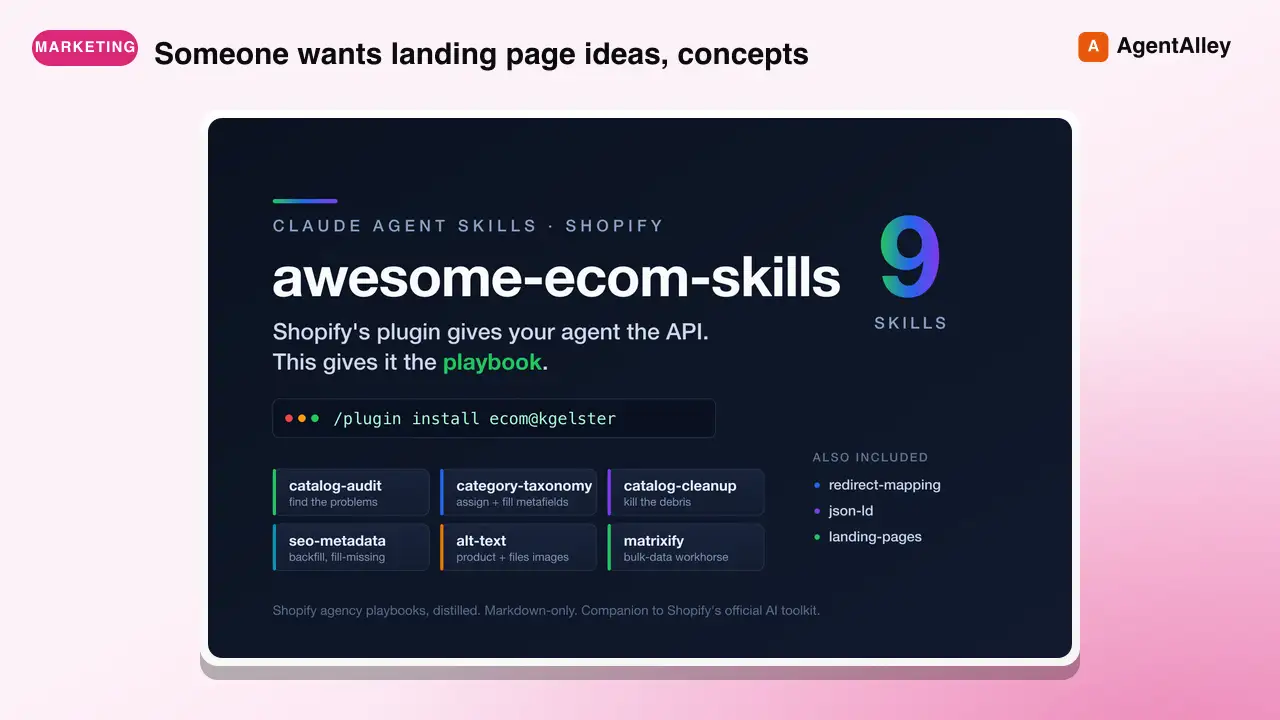
 kgelster/awesome-ecom-skills · by kgelsterUse when someone wants landing page ideas, concepts, or angles for a store: give me landing page concepts", "LP ideas", "landing page angles", a campaign or ad landing page, pages for a new audience/segment, a seasonal/event/promo page, or a geo/local page. Also use when a chosen concept gets picked and needs building out into an actual page (section-by-section blueprint), or when auditing an existing landing page against best practice. The core insight: one product becomes dozens of pages by varying the ANGLE, not the product. Not for full-site information architecture, product detail pages, collection pages, or blog/SEO content (a landing page has ONE goal, no site chrome). Use an SEO/content skill. Not for the ad or email creative itself, though message match with the page matters.★ 49 GitHub stars
 SkillDirect Response Copywriter
 Deupaxx/EveryDay-Writer · by DeupaxxWrite sales pages, email sequences, and direct-response copy that converts through clarity and specificity rather than manipulation. Use for launches, offers, and conversion-focused email. Enforces the EW anti-AI rules, proof standards, and the writer's voice profile.★ 32 GitHub stars
More from oathdriven
 SkillAEO Blog Writer
 oathdriven/rymac-skills · by oathdrivenWrites SEO + AEO (Answer Engine Optimized) blog posts built to rank on Google AND get cited by AI answer engines (Google AI Overviews, ChatGPT, Perplexity). Runs live SERP recon, writes answer-first, and wires internal + external authority links. Use when someone wants a blog post that ranks and gets quoted by AI, says "write an AEO post", "answer-engine optimization", "get cited by AI Overviews", "rank AND get quoted", or wants the pro version of an SEO article. For quick keyword blog posts use rymac-seo-writer instead.★ 28 GitHub stars
 SkillConverting Headline Writeroathdriven/rymac-skills · by oathdrivenWrite and rewrite landing-page headlines, hero sections, and their CTAs using a pain + dream-outcome formula, awareness-stage diagnosis, and a curated SaaS swipe file. Use when the user asks to "write a headline", "rewrite the hero", "fix the landing page headline", "give me headline options", "punch up the hero", or works on above-the-fold copy for allodra.ai, sierra6ai.com, or any writing-room landing page. Make sure to use this skill whenever a headline, hero section, subheadline, or CTA button copy is being written or critiqued.★ 28 GitHub stars
 SkillCall Scheduling Funneloathdriven/rymac-skills · by oathdrivenBuilds the conversion plumbing that turns site traffic into scheduled calls: chat scheduler, AI voice agent, emergency escalation that pings a live on-call human, non-emergency booking into one shared calendar engine, and after-hours handling. Use when the user asks to "wire up the call funnel", "add the chat scheduler", "set up the voice agent", "convert traffic into scheduled calls", "handle after-hours calls", or builds any page whose goal is booked calls. Make sure to use this skill whenever call-booking, voice-agent, or emergency-routing plumbing is being designed or built.★ 28 GitHub stars
 SkillDirect Response Letteroathdriven/rymac-skills · by oathdrivenWrites direct-response P.A.S. (Problem-Agitate-Solution) sales letters in the RyMac voice, in the Dan Kennedy direct-letter tradition, modeled on the proven Sierra-6 letter. A personal letter to one reader with self-identification pain bullets, "you're not alone" normalization, cinematic agitation, an I-was-you origin story, a named-mechanism reveal, imagine future-pacing, and a P.S. close, formatted for skimmers (bold/underline paths). Use when the user asks to "write a sales letter", "write the letter", "P.A.S. letter", "direct sales letter", "Dan Kennedy letter", "pain-agitate-solution copy", says "set up my sales letter voice profile", or needs the letter section of a sales page. Make sure to use this skill whenever long-form persuasive letter copy is being written, rewritten, or critiqued.★ 28 GitHub stars
 SkillExit Intent Popupoathdriven/rymac-skills · by oathdrivenBuilds RyMac's exit-intent popup pattern on any landing or sales page: desktop mouse-leave plus the mobile fast-scroll-up trigger, offering a supportive asset that is deliberately NEVER promised on the page itself. Use when the user asks to "add an exit pop", "build an exit popup", "exit intent", "catch people leaving the page", or when finishing any sales/landing page build. Make sure to use this skill whenever an exit-intent popup or leave-catcher is being designed, built, or critiqued.★ 28 GitHub stars
 SkillNiche Offer Validatoroathdriven/rymac-skills · by oathdrivenRuns RyMac's offer-validation research method. Fans out parallel subagents to map a niche's pain points in their own words, the psychology of why the pain persists, a competitor matrix, demand proof with a lead-pool count, the niche's unit economics (revenue bands, net margin range, where the margin comes from, the P&L split, average ticket), and a response-behavior audit scoring the niche against your mechanism, then delivers a build/pivot/skip verdict with the underserved wedge, the USP, an affordability call on what the niche can actually pay, a delivery-economics check that YOUR own margin clears a 65% floor (with the lowest price you could charge and the owned-vs-rented cost of your stack), the profit left on the table, and ROI hooks written in their own numbers. Use when the user asks to "research a niche", "validate an offer", "find the pain points", "run niche research", "should I build this", "who else sells this", "what are the margins in X", "can they afford my offer", "what should I price this at", or has an idea or observation about a market. Make sure to use this skill whenever the user is deciding what to build, sell, price, or make content about next.★ 28 GitHub stars