AI Pattern Remover
Stop slop
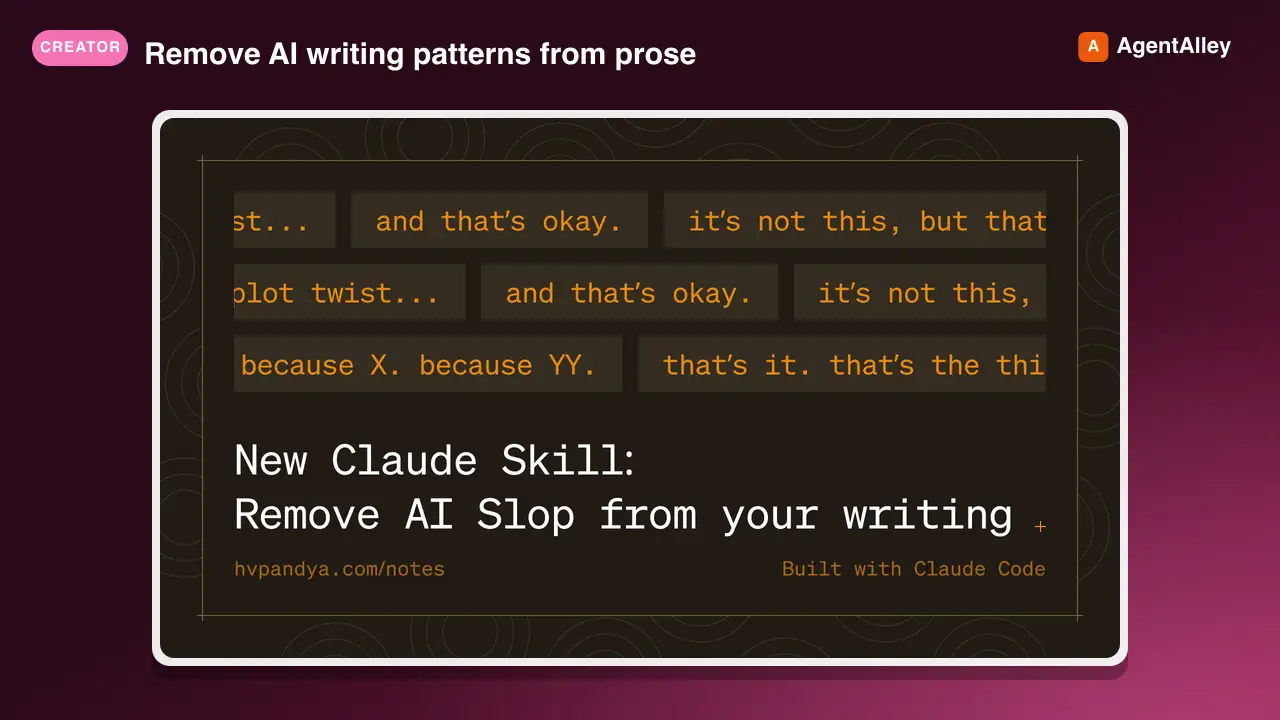
Remove AI writing patterns from prose. Use when drafting, editing, or reviewing text to eliminate predictable AI tells.
---
name: stop-slop
description: Remove AI writing patterns from prose. Use when drafting, editing, or reviewing text to eliminate predictable AI tells.
metadata:
  trigger: Writing prose, editing drafts, reviewing content for AI patterns
  author: Hardik Pandya (https://hvpandya.com)
---

# Stop Slop

Eliminate predictable AI writing patterns from prose.

## Core Rules

1. **Cut filler phrases.** Remove throat-clearing openers, emphasis crutches, and all adverbs. See [references/phrases.md](references/phrases.md).

2. **Break formulaic structures.** Avoid binary contrasts, negative listings, dramatic fragmentation, rhetorical setups, false agency. See [references/structures.md](references/structures.md).
Overview
See references/examples.md for before/after transformations.
Manual install (npx, ZIP)
npx skills add hardikpandya/stop-slop -g -a claude-codeConnects with Agent Alley MCP · agentalley.io/mcp
Files included
SKILL.md2.6 KB
Read SKILL.md here
hardikpandya/
Show the full text69 lines
Stop Slop
Eliminate predictable AI writing patterns from prose.
Core Rules
Cut filler phrases. Remove throat-clearing openers, emphasis crutches, and all adverbs. See references/phrases.md.
Break formulaic structures. Avoid binary contrasts, negative listings, dramatic fragmentation, rhetorical setups, false agency. See references/structures.md.
Use active voice. Every sentence needs a human subject doing something. No passive constructions. No inanimate objects performing human actions ("the complaint becomes a fix").
Be specific. No vague declaratives ("The reasons are structural"). Name the specific thing. No lazy extremes ("every," "always," "never") doing vague work.
Put the reader in the room. No narrator-from-a-distance voice. "You" beats "People." Specifics beat abstractions.
Vary rhythm. Mix sentence lengths. Two items beat three. End paragraphs differently. No em dashes.
Trust readers. State facts directly. Skip softening, justification, hand-holding.
Cut quotables. If it sounds like a pull-quote, rewrite it.
Quick Checks
Before delivering prose:
- Any adverbs? Kill them.
- Any passive voice? Find the actor, make them the subject.
- Inanimate thing doing a human verb ("the decision emerges")? Name the person.
- Sentence starts with a Wh- word? Restructure it.
- Any "here's what/this/that" throat-clearing? Cut to the point.
- Any "not X, it's Y" contrasts? State Y directly.
- Three consecutive sentences match length? Break one.
- Paragraph ends with punchy one-liner? Vary it.
- Em-dash anywhere? Remove it.
- Vague declarative ("The implications are significant")? Name the specific implication.
- Narrator-from-a-distance ("Nobody designed this")? Put the reader in the scene.
- Meta-joiners ("The rest of this essay...")? Delete. Let the essay move.
Scoring
Rate 1-10 on each dimension:
| Dimension | Question |
|---|---|
| Directness | Statements or announcements? |
| Rhythm | Varied or metronomic? |
| Trust | Respects reader intelligence? |
| Authenticity | Sounds human? |
| Density | Anything cuttable? |
Below 35/50: revise.
Examples
See references/examples.md for before/after transformations.
License
MIT
| 1 | |
| 2 | name stop-slop |
| 3 | description Remove AI writing patterns from prose. Use when drafting, editing, or reviewing text to eliminate predictable AI tells. |
| 4 | metadata |
| 5 | trigger Writing prose, editing drafts, reviewing content for AI patterns |
| 6 | author Hardik Pandya (https://hvpandya.com) |
| 7 | |
| 8 | |
| 9 | # Stop Slop |
| 10 | |
| 11 | Eliminate predictable AI writing patterns from prose. |
| 12 | |
| 13 | ## Core Rules |
| 14 | |
| 15 | **Cut filler phrases.** Remove throat-clearing openers, emphasis crutches, and all adverbs. See [references/phrases.md]. |
| 16 | |
| 17 | **Break formulaic structures.** Avoid binary contrasts, negative listings, dramatic fragmentation, rhetorical setups, false agency. See [references/structures.md]. |
| 18 | |
| 19 | **Use active voice.** Every sentence needs a human subject doing something. No passive constructions. No inanimate objects performing human actions ("the complaint becomes a fix"). |
| 20 | |
| 21 | **Be specific.** No vague declaratives ("The reasons are structural"). Name the specific thing. No lazy extremes ("every," "always," "never") doing vague work. |
| 22 | |
| 23 | **Put the reader in the room.** No narrator-from-a-distance voice. "You" beats "People." Specifics beat abstractions. |
| 24 | |
| 25 | **Vary rhythm.** Mix sentence lengths. Two items beat three. End paragraphs differently. No em dashes. |
| 26 | |
| 27 | **Trust readers.** State facts directly. Skip softening, justification, hand-holding. |
| 28 | |
| 29 | **Cut quotables.** If it sounds like a pull-quote, rewrite it. |
| 30 | |
| 31 | ## Quick Checks |
| 32 | |
| 33 | Before delivering prose: |
| 34 | |
| 35 | Any adverbs? Kill them. |
| 36 | Any passive voice? Find the actor, make them the subject. |
| 37 | Inanimate thing doing a human verb ("the decision emerges")? Name the person. |
| 38 | Sentence starts with a Wh- word? Restructure it. |
| 39 | Any "here's what/this/that" throat-clearing? Cut to the point. |
| 40 | Any "not X, it's Y" contrasts? State Y directly. |
| 41 | Three consecutive sentences match length? Break one. |
| 42 | Paragraph ends with punchy one-liner? Vary it. |
| 43 | Em-dash anywhere? Remove it. |
| 44 | Vague declarative ("The implications are significant")? Name the specific implication. |
| 45 | Narrator-from-a-distance ("Nobody designed this")? Put the reader in the scene. |
| 46 | Meta-joiners ("The rest of this essay...")? Delete. Let the essay move. |
| 47 | |
| 48 | ## Scoring |
| 49 | |
| 50 | Rate 1-10 on each dimension: |
| 51 | |
| 52 | | Dimension | Question | |
| 53 | |-----------|----------| |
| 54 | | Directness | Statements or announcements? | |
| 55 | | Rhythm | Varied or metronomic? | |
| 56 | | Trust | Respects reader intelligence? | |
| 57 | | Authenticity | Sounds human? | |
| 58 | | Density | Anything cuttable? | |
| 59 | |
| 60 | Below 35/50: revise. |
| 61 | |
| 62 | ## Examples |
| 63 | |
| 64 | See [references/examples.md] for before/after transformations. |
| 65 | |
| 66 | ## License |
| 67 | |
| 68 | MIT |
| 69 |
Details
- License
- MIT
- Stars on the repo
- ★ 17,826
- Checked
- Source
- hardikpandya/stop-slop ↗
- Creator
- hardikpandya · 1 listing
Similar skills
See all →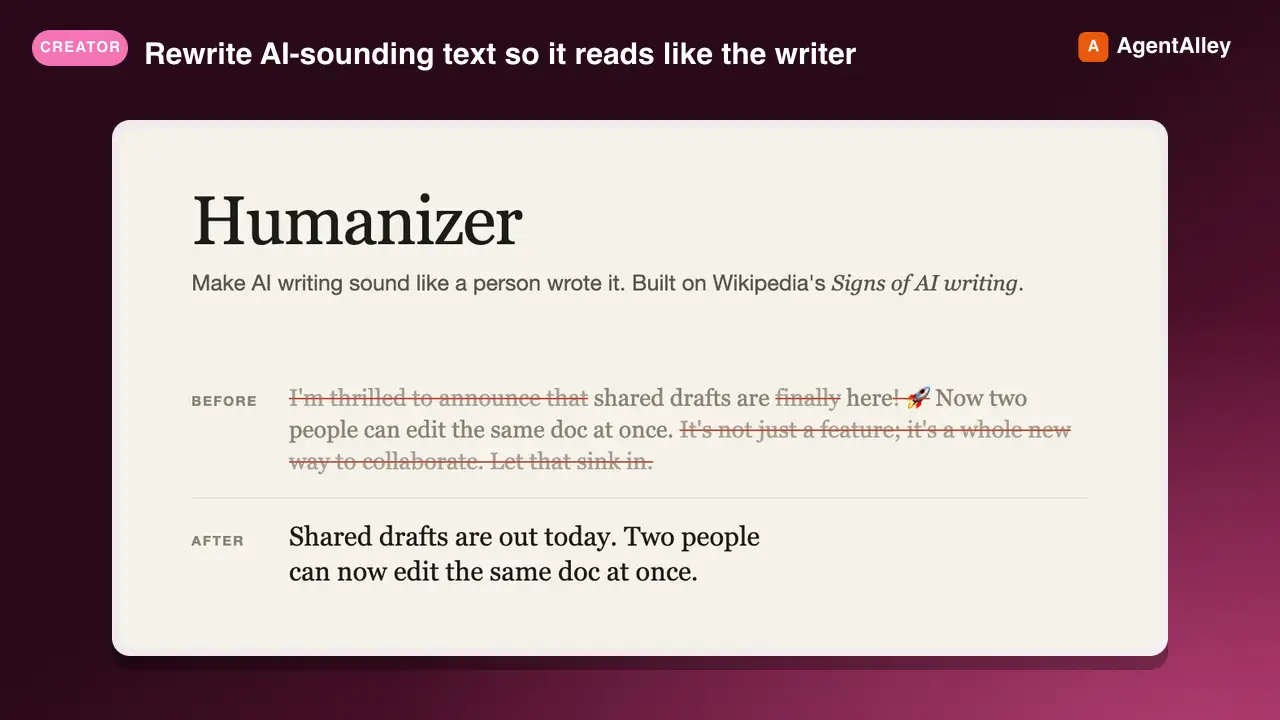 SkillProse Naturalizer
 blader/humanizer · by bladerRewrite AI-sounding text so it reads like the writer without changing what it says. Use when editing or reviewing prose for AI tells: not-X-but-Y contrasts, one-line closers, staged openers, forced triads, dashes everywhere, inflated claims, sales language, stock AI words, bold labels, or filler. Based on Wikipedia's "Signs of AI writing.★ 53.6k GitHub stars
 SkillAI Slop Editor
 petergyang/no-ai-slop · by petergyangEdit drafts into sharper, more human writing while preserving the writer's personal voice, or detect AI-slop patterns without rewriting. Use when the user wants a draft clearer, more direct, more opinionated, or less AI-sounding, or asks whether writing reads as AI.★ 12k GitHub stars
 SkillAI Writing Pattern Detector
 conorbronsdon/avoid-ai-writing · by conorbronsdonUse when the user asks to detect, scan, audit, score, or flag AI-writing patterns without rewriting the text, including requests for a deterministic local detector result when the host can execute Node.★ 4.7k GitHub stars
 SkillAI Writing Auditorconorbronsdon/avoid-ai-writing · by conorbronsdonAudit and rewrite content to remove AI writing patterns ("AI-isms"). Use this skill when asked to "remove AI-isms," "clean up AI writing," "edit writing for AI patterns," "audit writing for AI tells," or "make this sound less like AI." Supports a detect-only mode, an edit-in-place mode for files, an optional voice profile (casual / professional / technical / warm / blunt), and an iterate-to-convergence pass.★ 4.7k GitHub stars
 SkillDe-AI Writing
 Nanako0129/sepia · by Nanako0129Make AI-generated writing read as human-written, in fiction and in professional prose. Repairs the narrative architecture of fiction and stories (based on StoryScope, arXiv:2604.03136); routes professional text through domain rules for release notes, announcements, PR and issue replies, code-review comments, incident postmortems, tickets, work orders, technical articles, blog posts, and long-form journalism. Four operations - write, review (diagnose AI tells without editing), refactor (minimal in-place edits), recreate (full rewrite). Use when asked to humanize, de-AI, unslop, or strip AI flavor from any text; when writing or revising any of these document types; or whenever output must not read as machine-written.★ 3.1k GitHub stars
 SkillAI Slop Detection Method
 AgriciDaniel/claude-blog · by AgriciDanielA phrase blocklist catches the obvious tells. Most AI-generated prose passes that filter and still reads like AI. The structural tics, the…★ 2.2k GitHub stars