Transparency Sales Method
Transparency Sale (Todd Caponi)
Execute Todd Caponi's Transparency Sale methodology — lead with flaws, build the "Our Flaws" slide, negotiate with radical honesty, use the 4.2-4.5 effect in positioning. Use when building pitch decks, handling objections, negotiating,…
---
name: transparency-selling
description: >-
  Execute Todd Caponi's Transparency Sale methodology — lead with flaws,
  build the "Our Flaws" slide, negotiate with radical honesty, use the
  4.2-4.5 effect in positioning. Use when building pitch decks, handling
  objections, negotiating, or designing sales process. Triggers on:
  "transparency sale", "lead with flaws", "Todd Caponi", "radical honesty",
  "transparent selling", "our flaws slide".
license: MIT
compatibility: Claude Code, Codex, GitHub Copilot, Cursor, Gemini CLI, OpenCode, Goose, Hermes, Windsurf, Zed
metadata:
  version: "1.0.0"
  author: LeadMagic
  category: sales-revops
  tags: [transparency-sale, Todd-Caponi, radical-honesty, trust, negotiation]
  related_skills: [buyer-psychology, pitch-deck-builder, objection-handling, deal-desk, competitive-intel, battlecard-builder]
  frameworks: [Todd Caponi Transparency Sale, Arthur Dunn Scientific Selling, Kahneman System 1/2]
Overview
Arthur Dunn's Law (1919): "If the truth won't sell it, don't sell it."
Manual install (npx, ZIP)
npx skills add LeadMagic/gtm-skills --skill transparency-selling -g -a claude-codenpx degit LeadMagic/gtm-skills/skills/sales-revops/transparency-selling#main ~/.claude/skills/transparency-sellingConnects with Agent Alley MCP · agentalley.io/mcp
Files included
SKILL.md8.7 KB
Read SKILL.md here
Show the full text199 lines
Transparency Sale (Todd Caponi)
Overview
The Transparency Sale by Todd Caponi flips traditional sales on its head: instead of hiding flaws and presenting perfection, you LEAD with your weaknesses. This builds trust faster, shortens sales cycles, increases win rates, and makes competing against you nearly impossible — because you've already said what competitors would try to weaponize.
Core Principle
Transparency sells better than perfection. Products with average ratings between 4.2 and 4.5 convert better than perfect 5.0 ratings. Buyers don't buy when they're convinced — they buy when they can predict. Leading with your flaws accelerates prediction and builds trust that perfection never could.
Arthur Dunn's Law (1919): "If the truth won't sell it, don't sell it."
When to Use
- "Build a transparency-based pitch"
- "Our Flaws slide"
- "Todd Caponi methodology"
- "Lead with weaknesses"
- "Radical honesty in sales"
- "Transparent negotiation"
Authoritative Foundations
- Todd Caponi — The Transparency Sale. Research on the 4.2-4.5 rating effect, the buying brain's resistance to influence, prediction over persuasion, and why negative reviews increase conversion.
- Arthur Dunn — Scientific Selling (1919). The original insight that truth is a sales methodology, not just a value. "If the truth won't sell it, don't sell it."
- Daniel Kahneman — System 1/2 thinking. Buyers' fast brains detect bullshit instantly. Transparency engages the slow brain productively.
Step-by-Step Process
Phase 1: Build Your Flaws Inventory
Before you can lead with flaws, you need to know them. Inventory honestly:
- Feature gaps: What does a competitor do that you don't? Be specific.
- Use case limits: What types of companies/use cases are you bad for?
- Customer complaints: What do real customers say in negative reviews?
- Pricing objections: Where are you genuinely more expensive, and why?
- Implementation friction: What's hard about getting started with you?
- Industry segments: Where do you consistently lose deals?
For each flaw, map: the flaw → who it matters to → who it DOESN'T matter to. One person's dealbreaker is another's irrelevance. Context transforms flaws into qualifiers.
Phase 2: Build the "Our Flaws" Slide
Every pitch deck should include a slide titled "When We're Not the Right Fit" or "Our Flaws" before the product tour:
Our Flaws

1. We're not the best fit if you need [X specific capability].
   → Our competitor [Name] does this better. If this is critical,
     we'll tell you and help you evaluate them.

2. Customers tell us [Y] could be better.
   → Here's what we're doing about it: [specific timeline/plan].

3. Our pricing isn't the cheapest in the market.
   → Here's why: [specific value justification]. If budget is the
     primary driver, [Alternative] may be a better fit.

4. We lost deals when [Z specific scenario].
   → If your situation looks like this, let's talk about whether
     this is the right fit.
Rules for the Flaws slide:
- Must be REAL flaws, not humblebrags ("We work too hard!")
- Must include at least one thing a competitor does better
- Must include at least one genuine customer complaint
- Must include the context of who it matters to and who it doesn't
Phase 3: Transparency Throughout the Sales Cycle
Discovery Call:
- "Before we dive in — here are 3 situations where we're probably not the right fit. If any of these sound like you, I'll tell you honestly and we can save each other time."
Demo:
- Show the product warts-and-all. If a feature is clunky, say "This isn't our best feature yet — here's the plan to improve it." Don't skip the ugly parts — they'll find them anyway. Finding them WITH you builds trust; finding them WITHOUT you builds suspicion.
Objection Handling:
- Agree first: "That's a fair concern."
- Validate: "Other customers felt the same way initially."
- Contextualize: "Here's what they found after 90 days..."
- The key: never deflect. Acknowledge the objection is REAL before you address it. Buyers know when you're dodging.
Pricing Conversation:
- "Here's the price. Here's exactly what drives it. Here's why we don't discount. If budget is tight, here's the light version that might work."
- No hidden fees. No "let me check with my manager." No discount theater. Pricing transparency is the fastest trust-builder in B2B.
Phase 4: Transparent Negotiation
Caponi's negotiation principles:
- No surprises. If discount is needed, discuss it early — don't spring a price change at the end. Surprises at closing kill deals.
- Single offer. Don't negotiate against yourself. Present your best offer once. "This is the best we can do. Here's why. If it doesn't work, I understand."
- Trade, don't concede. Every discount gets a trade: "We can reduce price by X if you're willing to [annual commitment / case study / reference call / faster implementation]."
- Walk-away price. Know your floor. If they can't meet it, walk away warmly. "I wish we could make this work. If your situation changes, I'd love to reconnect."
- Post-agreement reinforcement. After the deal closes, reinforce why it was the right decision. Buyer's remorse peaks 48-72 hours after signing. A transparency call during this window reduces churn.
Phase 5: Building a Transparency Culture
Transparency isn't a tactic — it's an operating system:
- Pipeline reviews: "Which deals should we NOT be pursuing?" is as important as "Which deals are closing?"
- Loss reviews: Celebrate fast losses. "We disqualified this deal in 2 weeks because we were honest about our gaps" is a WIN.
- Customer feedback: Publish NPS scores internally. Share negative reviews with the whole company. The fastest way to fix problems is to make them visible.
- Sales hiring: Hire for honesty over confidence. The rep who says "I don't know, let me find out" will outsell the one who has an answer for everything.
Output Format
Transparency Sale playbook with: flaws inventory, "Our Flaws" slide, sales cycle transparency map, negotiation playbook, and culture checklist.
Quality Check
- Flaws are REAL, not humblebrags
- At least one competitor is named as better at something
- At least one real customer complaint is included
- Context is provided for each flaw (who it matters to, who it doesn't)
- No discount theater — pricing is transparent
Common Pitfalls
Humblebragging as transparency. "We care too much" is not a flaw. "Our reporting module lags behind Looker" is a flaw. If you can't name a specific competitor who does something better, you're not being transparent.
Leading with flaws but not context. "We're expensive" without "here's why" is just bad marketing. Every flaw must include: who it matters to, who it doesn't, and why your customers still choose you.
Transparency as a phase, not a system. Doing transparency in the first call and then reverting to traditional selling destroys trust. Consistency is the mechanism — one inconsistency erases ten consistencies.
Execution Artifacts
references/framework-notes.md— Named frameworks and reference tablestemplates/output-template.md— Deliverable shell for agent outputscripts/check-output.py— Lightweight deliverable validator
Related Skills
- buyer-psychology: The decision science behind why transparency works
- pitch-deck-builder: Build the deck that includes "Our Flaws"
- objection-handling: Transparency-based objection responses
- deal-desk: Transparent pricing and negotiation
- competitive-intel: Honest competitive positioning
- battlecard-builder: Build battlecards that acknowledge competitor strengths
| 1 | |
| 2 | name transparency-selling |
| 3 | description >- |
| 4 | Execute Todd Caponi's Transparency Sale methodology — lead with flaws, |
| 5 | build the "Our Flaws" slide, negotiate with radical honesty, use the |
| 6 | 4.2-4.5 effect in positioning. Use when building pitch decks, handling |
| 7 | objections, negotiating, or designing sales process. Triggers on: |
| 8 | "transparency sale", "lead with flaws", "Todd Caponi", "radical honesty", |
| 9 | "transparent selling", "our flaws slide". |
| 10 | license MIT |
| 11 | compatibility Claude Code, Codex, GitHub Copilot, Cursor, Gemini CLI, OpenCode, Goose, Hermes, Windsurf, Zed |
| 12 | metadata |
| 13 | version "1.0.0" |
| 14 | author LeadMagic |
| 15 | category sales-revops |
| 16 | tags [transparency-sale, Todd-Caponi, radical-honesty, trust, negotiation] |
| 17 | related_skills [buyer-psychology, pitch-deck-builder, objection-handling, deal-desk, competitive-intel, battlecard-builder] |
| 18 | frameworks [Todd Caponi Transparency Sale, Arthur Dunn Scientific Selling, Kahneman System 1/2] |
| 19 | |
| 20 | |
| 21 | # Transparency Sale (Todd Caponi) |
| 22 | |
| 23 | ## Overview |
| 24 | The Transparency Sale by Todd Caponi flips traditional sales on its head: |
| 25 | instead of hiding flaws and presenting perfection, you LEAD with your |
| 26 | weaknesses. This builds trust faster, shortens sales cycles, increases |
| 27 | win rates, and makes competing against you nearly impossible — because |
| 28 | you've already said what competitors would try to weaponize. |
| 29 | |
| 30 | ## Core Principle |
| 31 | |
| 32 | > Transparency sells better than perfection. Products with average ratings |
| 33 | > between 4.2 and 4.5 convert better than perfect 5.0 ratings. Buyers don't |
| 34 | > buy when they're convinced — they buy when they can predict. Leading with |
| 35 | > your flaws accelerates prediction and builds trust that perfection never could. |
| 36 | |
| 37 | **Arthur Dunn's Law (1919):** "If the truth won't sell it, don't sell it." |
| 38 | |
| 39 | ## When to Use |
| 40 | "Build a transparency-based pitch" |
| 41 | "Our Flaws slide" |
| 42 | "Todd Caponi methodology" |
| 43 | "Lead with weaknesses" |
| 44 | "Radical honesty in sales" |
| 45 | "Transparent negotiation" |
| 46 | |
| 47 | ## Authoritative Foundations |
| 48 | **Todd Caponi** — The Transparency Sale. Research on the 4.2-4.5 rating |
| 49 | effect, the buying brain's resistance to influence, prediction over |
| 50 | persuasion, and why negative reviews increase conversion. |
| 51 | **Arthur Dunn** — Scientific Selling (1919). The original insight that |
| 52 | truth is a sales methodology, not just a value. "If the truth won't sell |
| 53 | it, don't sell it." |
| 54 | **Daniel Kahneman** — System 1/2 thinking. Buyers' fast brains detect |
| 55 | bullshit instantly. Transparency engages the slow brain productively. |
| 56 | |
| 57 | ## Step-by-Step Process |
| 58 | |
| 59 | ### Phase 1: Build Your Flaws Inventory |
| 60 | Before you can lead with flaws, you need to know them. Inventory honestly: |
| 61 | |
| 62 | **Feature gaps:** What does a competitor do that you don't? Be specific. |
| 63 | **Use case limits:** What types of companies/use cases are you bad for? |
| 64 | **Customer complaints:** What do real customers say in negative reviews? |
| 65 | **Pricing objections:** Where are you genuinely more expensive, and why? |
| 66 | **Implementation friction:** What's hard about getting started with you? |
| 67 | **Industry segments:** Where do you consistently lose deals? |
| 68 | |
| 69 | For each flaw, map: the flaw → who it matters to → who it DOESN'T matter to. |
| 70 | One person's dealbreaker is another's irrelevance. Context transforms flaws |
| 71 | into qualifiers. |
| 72 | |
| 73 | ### Phase 2: Build the "Our Flaws" Slide |
| 74 | Every pitch deck should include a slide titled "When We're Not the Right Fit" |
| 75 | or "Our Flaws" before the product tour: |
| 76 | |
| 77 | |
| 78 | Our Flaws |
| 79 | |
| 80 | 1. We're not the best fit if you need [X specific capability]. |
| 81 | → Our competitor [Name] does this better. If this is critical, |
| 82 | we'll tell you and help you evaluate them. |
| 83 | |
| 84 | 2. Customers tell us [Y] could be better. |
| 85 | → Here's what we're doing about it: [specific timeline/plan]. |
| 86 | |
| 87 | 3. Our pricing isn't the cheapest in the market. |
| 88 | → Here's why: [specific value justification]. If budget is the |
| 89 | primary driver, [Alternative] may be a better fit. |
| 90 | |
| 91 | 4. We lost deals when [Z specific scenario]. |
| 92 | → If your situation looks like this, let's talk about whether |
| 93 | this is the right fit. |
| 94 | |
| 95 | |
| 96 | **Rules for the Flaws slide:** |
| 97 | Must be REAL flaws, not humblebrags ("We work too hard!") |
| 98 | Must include at least one thing a competitor does better |
| 99 | Must include at least one genuine customer complaint |
| 100 | Must include the context of who it matters to and who it doesn't |
| 101 | |
| 102 | ### Phase 3: Transparency Throughout the Sales Cycle |
| 103 | |
| 104 | **Discovery Call:** |
| 105 | "Before we dive in — here are 3 situations where we're probably not the |
| 106 | right fit. If any of these sound like you, I'll tell you honestly and |
| 107 | we can save each other time." |
| 108 | |
| 109 | **Demo:** |
| 110 | Show the product warts-and-all. If a feature is clunky, say "This isn't |
| 111 | our best feature yet — here's the plan to improve it." Don't skip the |
| 112 | ugly parts — they'll find them anyway. Finding them WITH you builds trust; |
| 113 | finding them WITHOUT you builds suspicion. |
| 114 | |
| 115 | **Objection Handling:** |
| 116 | Agree first: "That's a fair concern." |
| 117 | Validate: "Other customers felt the same way initially." |
| 118 | Contextualize: "Here's what they found after 90 days..." |
| 119 | The key: never deflect. Acknowledge the objection is REAL before you |
| 120 | address it. Buyers know when you're dodging. |
| 121 | |
| 122 | **Pricing Conversation:** |
| 123 | "Here's the price. Here's exactly what drives it. Here's why we don't |
| 124 | discount. If budget is tight, here's the light version that might work." |
| 125 | No hidden fees. No "let me check with my manager." No discount theater. |
| 126 | Pricing transparency is the fastest trust-builder in B2B. |
| 127 | |
| 128 | ### Phase 4: Transparent Negotiation |
| 129 | Caponi's negotiation principles: |
| 130 | |
| 131 | **No surprises.** If discount is needed, discuss it early — don't spring |
| 132 | a price change at the end. Surprises at closing kill deals. |
| 133 | **Single offer.** Don't negotiate against yourself. Present your best |
| 134 | offer once. "This is the best we can do. Here's why. If it doesn't work, |
| 135 | I understand." |
| 136 | **Trade, don't concede.** Every discount gets a trade: "We can reduce |
| 137 | price by X if you're willing to [annual commitment / case study / reference |
| 138 | call / faster implementation]." |
| 139 | **Walk-away price.** Know your floor. If they can't meet it, walk away |
| 140 | warmly. "I wish we could make this work. If your situation changes, |
| 141 | I'd love to reconnect." |
| 142 | **Post-agreement reinforcement.** After the deal closes, reinforce why |
| 143 | it was the right decision. Buyer's remorse peaks 48-72 hours after |
| 144 | signing. A transparency call during this window reduces churn. |
| 145 | |
| 146 | ### Phase 5: Building a Transparency Culture |
| 147 | Transparency isn't a tactic — it's an operating system: |
| 148 | |
| 149 | **Pipeline reviews:** "Which deals should we NOT be pursuing?" is as |
| 150 | important as "Which deals are closing?" |
| 151 | **Loss reviews:** Celebrate fast losses. "We disqualified this deal in |
| 152 | 2 weeks because we were honest about our gaps" is a WIN. |
| 153 | **Customer feedback:** Publish NPS scores internally. Share negative |
| 154 | reviews with the whole company. The fastest way to fix problems is to |
| 155 | make them visible. |
| 156 | **Sales hiring:** Hire for honesty over confidence. The rep who says |
| 157 | "I don't know, let me find out" will outsell the one who has an answer |
| 158 | for everything. |
| 159 | |
| 160 | ## Output Format |
| 161 | Transparency Sale playbook with: flaws inventory, "Our Flaws" slide, sales |
| 162 | cycle transparency map, negotiation playbook, and culture checklist. |
| 163 | |
| 164 | ## Quality Check |
| 165 | [ ] Flaws are REAL, not humblebrags |
| 166 | [ ] At least one competitor is named as better at something |
| 167 | [ ] At least one real customer complaint is included |
| 168 | [ ] Context is provided for each flaw (who it matters to, who it doesn't) |
| 169 | [ ] No discount theater — pricing is transparent |
| 170 | |
| 171 | ## Common Pitfalls |
| 172 | |
| 173 | **Humblebragging as transparency.** "We care too much" is not a flaw. |
| 174 | "Our reporting module lags behind Looker" is a flaw. If you can't name |
| 175 | a specific competitor who does something better, you're not being |
| 176 | transparent. |
| 177 | |
| 178 | **Leading with flaws but not context.** "We're expensive" without "here's |
| 179 | why" is just bad marketing. Every flaw must include: who it matters to, |
| 180 | who it doesn't, and why your customers still choose you. |
| 181 | |
| 182 | **Transparency as a phase, not a system.** Doing transparency in the |
| 183 | first call and then reverting to traditional selling destroys trust. |
| 184 | Consistency is the mechanism — one inconsistency erases ten consistencies. |
| 185 | |
| 186 | ## Execution Artifacts |
| 187 | |
| 188 | `references/framework-notes.md` — Named frameworks and reference tables |
| 189 | `templates/output-template.md` — Deliverable shell for agent output |
| 190 | `scripts/check-output.py` — Lightweight deliverable validator |
| 191 | |
| 192 | ## Related Skills |
| 193 | buyer-psychology: The decision science behind why transparency works |
| 194 | pitch-deck-builder: Build the deck that includes "Our Flaws" |
| 195 | objection-handling: Transparency-based objection responses |
| 196 | deal-desk: Transparent pricing and negotiation |
| 197 | competitive-intel: Honest competitive positioning |
| 198 | battlecard-builder: Build battlecards that acknowledge competitor strengths |
| 199 |
Details
- License
- MIT
- Stars on the repo
- ★ 62
- Checked
- Source
- LeadMagic/gtm-skills ↗
- Creator
- LeadMagic · 129 listings
Similar skills
See all → SkillAphorism Library Manager
 danielmiessler/LifeOS · by danielmiesslerCurated aphorism collection with CRUD — content-based matching, themed search, thinker research, DB maintenance. Quotes organized by author/theme/context/usage to prevent repetition. Four workflows: FindAphorism, AddAphorism, ResearchThinker, SearchAphorisms. Themes: Stoicism, Wisdom, Truth-seeking, Excellence, Resilience, Curiosity. USE WHEN aphorism, quote, find a quote, research thinker, add aphorism, quote for newsletter, what did X say about, quote bank. NOT FOR creative writing or social posts.★ 19.3k GitHub stars
 SkillCommercial Deal Negotiator
 cbrock84/headcount · by cbrock84Negotiates a commercial deal without giving away the terms that matter — preparing your walk-away and theirs, trading concessions rather than conceding them, recognizing the tactics that create false urgency, protecting price by moving other variables, and closing on terms someone can actually deliver. Use this to prepare for a negotiation, respond to a demand mid-deal, work out why discounts keep landing at quarter end, or review terms before they are signed.★ 2k GitHub stars
 SkillNegotiation & Influence
 samber/cc-skills · by samberInfluence and negotiation toolkit for any interaction needing another person's agreement, even when the user never says 'negotiation'. Covers B2B sales, salary reviews and raise asks, collective bargaining and unions, hard 1:1s, recruitment closes, cross-cultural deals, mediation, and diplomatic messages — declining, pushing back on scope, justifying a delay, raising a concern, getting alignment. Use when the user says 'they just said X, what do I say' or 'draft a reply', or mentions a buyer, champion, procurement, RFP, sponsor, HR, union, or candidate, or a pushback, refusal, ghosting, no-decision, escalation, fixed budget, counter-offer, comp band, strike, BATNA, anchor, or concession.★ 222 GitHub stars
 SkillProfessional Case Study Builder
 realjaymes/marketingagentskills · by realjaymesCreates professional case studies, engagement summaries, and project summaries. Use when the user wants to create a 'case study,' 'client success story,' 'engagement summary,' 'project summary,' or 'portfolio piece.'★ 65 GitHub stars
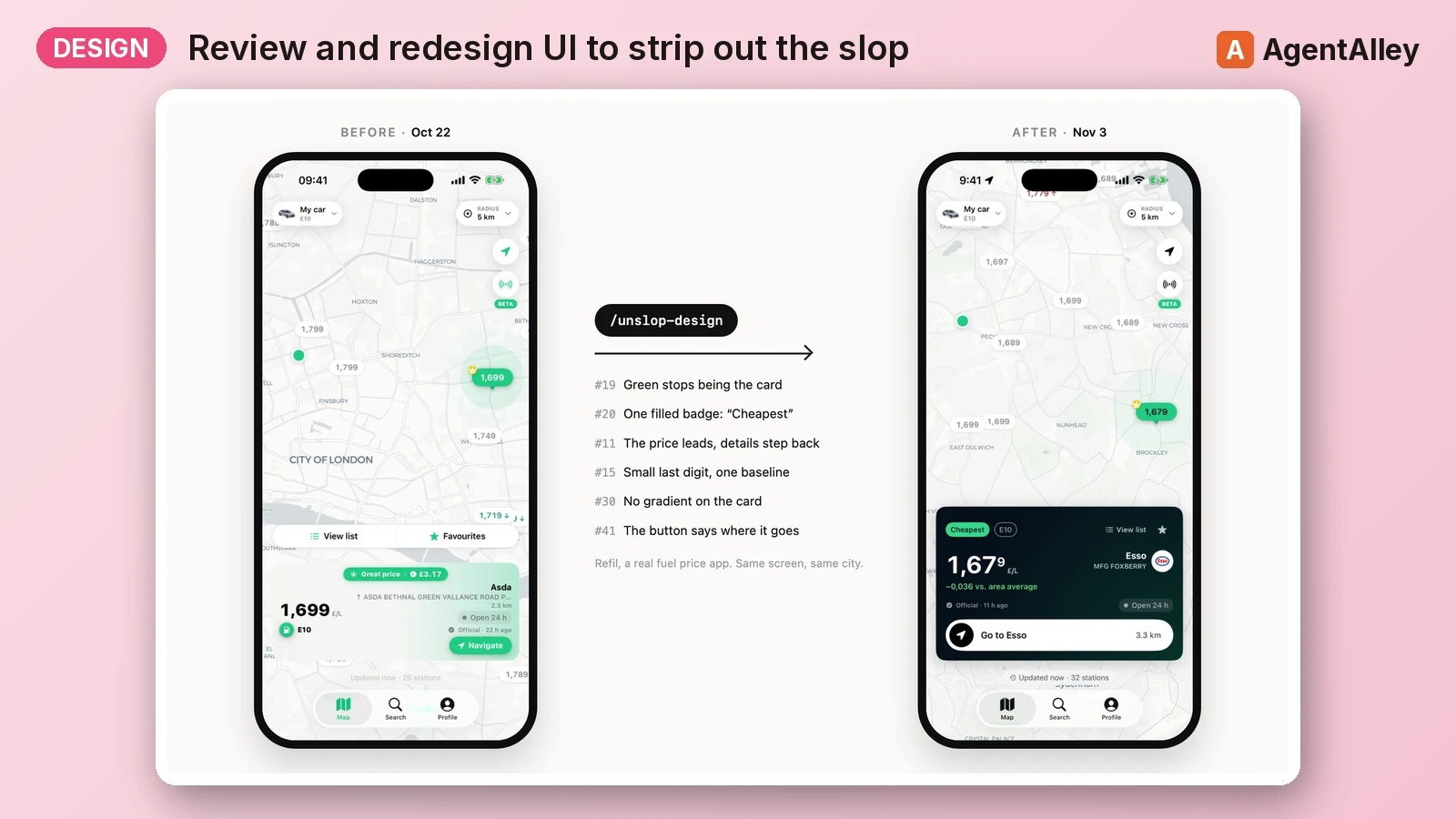 SkillUnslop Design Review
 marcosnovo/unslop-design · by marcosnovoReview and redesign an app or website UI to strip out the "slop" (decorative accent color, gradients, glows, noisy badges, emoji as icons, eyeballed spacing, greetings as titles, Title Case, flat hierarchy, repeated numbers) with a system (spacing, type, color roles, elevation) and two modes: a quick five-fix pass for one screen, or an orchestrated process for a whole app (parallel reviewers, a published winning proposal, devs per area, audits, PR). Covers SwiftUI, Compose and web (dashboards, landing pages, Tailwind), with scripts that scan the code, measure the rendered page and score it from 0 to 100. Use it when asked to "review the design", "make it look less AI", "unslop", "polish this screen", "design review", "winning proposal", "audit this dashboard", or when given videos or screenshots of an app or site asking for feedback or a redesign. Also use it to start a design system (spacing, type, palette, shadow scales) or to audit tokens, contrast or consistency across screens.★ 14 GitHub stars
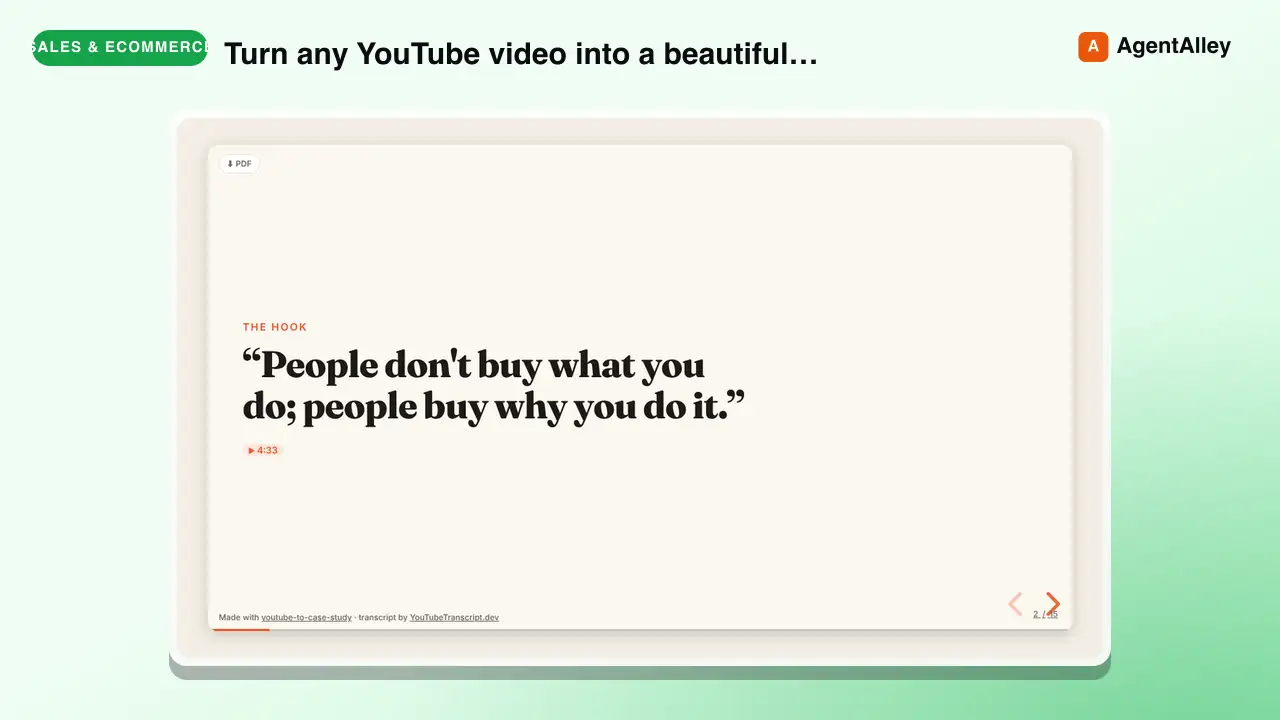 SkillYouTube to Case Study Converter
 tstfully/youtube-to-case-study · by tstfullyTurn any YouTube video (founder interview, product teardown, conference talk, marketing breakdown, UX walkthrough, podcast) into a beautiful case-study slideshow: one HTML file that opens in any browser, built on reveal.js, with speaker notes and every fact linked to the exact second in the video. Use this skill whenever someone wants a case study, business case study, marketing case study, UX case study, product teardown, growth teardown, competitor breakdown, swipe file, lesson deck, or presentation / slides / deck from a YouTube video or link. Also trigger on 'turn this video into a case study', 'make slides from this YouTube video', 'case study from this talk', 'teardown of this video', 'youtube to slides', 'youtube to presentation', or 'summarize this video as a deck'. Works for marketers, educators, product managers, students, and consultants; no coding needed.★ 3 GitHub stars
More from LeadMagic
 SkillFirst-Party Analytics Setup
 LeadMagic/gtm-skills · by LeadMagicSet up first-party tracking and analytics — website pixels, conversion tracking, UTM architecture, cookie consent, server-side tagging vs client-side, 1P vs 3P data strategy, and identity resolution. Use when setting up tracking, implementing pixels, building attribution, or preparing for privacy-first measurement. Triggers on: "pixel", "tracking", "conversion tracking", "first-party data", server-side tagging", "UTM", "cookie consent", "1P vs 3P", "identity resolution", or any tracking implementation request.★ 62 GitHub stars
 SkillStrategic Account MarketingLeadMagic/gtm-skills · by LeadMagicRuns strategic 1-to-1 ABM for 5-15 high-value accounts: account plans, custom microsites, executive engagement, direct mail, and board-level connections. Use when a named enterprise account justifies bespoke content and executive time, or when the user needs a strategic account plan. Triggers on: "1-to-1 ABM", "strategic ABM", "custom ABM", "key account marketing", "named account".★ 62 GitHub stars
 SkillCluster Account MarketingLeadMagic/gtm-skills · by LeadMagicRuns ABM at scale (1-to-few) for 15-50 clustered accounts: industry or persona clusters, semi-custom campaigns, and cluster-level content. Use when named-account ABM needs to reach more accounts without bespoke work per account. Triggers on: "1-to-few ABM", "ABM scale", "cluster ABM", "industry ABM".★ 62 GitHub stars
 SkillProgrammatic Account TargetingLeadMagic/gtm-skills · by LeadMagicRuns programmatic 1-to-many ABM for 50-200+ accounts: automated personalization, scaled outbound, intent-based targeting, and lookalike expansion. Use when ABM coverage must grow without adding headcount or when the user wants automated account-based outreach. Triggers on: "1-to-many ABM", programmatic ABM", "scaled ABM", "automated ABM".★ 62 GitHub stars
 SkillAccount Strategy DesignerLeadMagic/gtm-skills · by LeadMagicDesigns an account-based marketing program: tier selection, account scoring, channel orchestration, BDR alignment (account-based sales development), and a measurement framework. Use when the user is launching or redesigning ABM, choosing between 1-to-1, 1-to-few, and 1-to-many, or building a target account program. Triggers on: "ABM strategy", "account based marketing", "ABM playbook", "design ABM", "target accounts", "ABSD", "account based sales development", "Lars Nilsson".★ 62 GitHub stars
 SkillTarget Account SelectorLeadMagic/gtm-skills · by LeadMagicBuilds and tiers a target account list: fit and intent scoring models, tier assignment, and TAM segmentation. Use when the user needs to decide which accounts to target, score or tier an account list, or prioritize a TAM for ABM or outbound. Triggers on: "account selection", "target account list", "tier accounts", "prioritize accounts", "TAM segmentation".★ 62 GitHub stars